This series of posts was inspired by the Popsmart Instagram series Films for Fighting Fascism by Professor Shannon Mancus. She’s much smarter than I am and has more degrees than I do but I bet I’ve read more comics than her.
(Note: this post contains affiliate links. If you purchase something through this post I will get a small commission at no extra cost to you)
American Hate Rallies
Madison Square Garden holds 20,000 people. It’s been a venue for musicians, artists, comedians, sporting events, and has been home to at least two American hate rallies. These rallies centered around a buffoonish leader who worshiped a foreign authoritarian and wanted to spread a message of violence, othering, and fear to the American people.
In 1939, a man named Fritz Julius Kuhn, head of the German American Bund, spoke on stage with a huge portrait of George Washington behind him. Framing the portrait were two American flags and two banners with large swastikas emblazoned on them.
At the time, the mayor of New York, Fiorello LaGuardia had been warned that this rally could be dangerous. This was before America entered the war and the government had thus far assumed an isolationist position. The goal of the Bund was to sway sentiment to bring America to war on the side of the Nazis. LaGuardia allowed the rally to proceed, noting free speech rights. He did believe the rally would be the downfall of the hate group, later stating, “I believe in exposing the cooties to the sunlight, and we recently had an exhibition of international cooties.”
While the mayor had a point in letting the buffoonery play out, there was one man who directly stood up to Kuhn in the moment. Isadore Greenbaum had seen the advertising for the rally and wanted to see what all the fuss was about. He was well aware a hateful little man was going to be speaking in front of a large crowd. What Greenbaum did not expect was what he observed in the crowd. As the rally went on, he saw the speakers become more hateful, more antisemitic by the minute, and he saw several of his neighbors, friends and colleagues cheering for the speaker. Greenbaum did not plan any sort of protest but observing what he knew to be wrong, he rushed the stage and unplugged the microphones. He was promptly beaten by members of the Bund for it. This was exactly the kind of violence Kuhn wanted to stir.
The rally received international attention. There was an atmosphere of fear and anger brewing on both sides of the rally. While there were definitely more people strongly opposed to Nazism, there were pockets of America where the ideology was gaining ground. America’s position on what to do about the war taking place in Europe was not truly cemented until after the Pearl Harbor attack in December, 1941. The debacle of the Bund rally may have changed some minds. But mostly in favor of fighting rather than joining the Nazis.
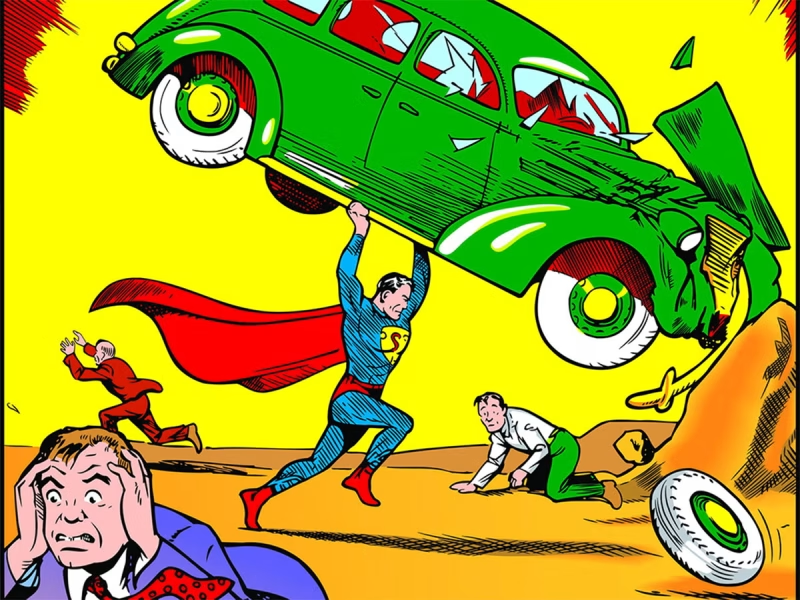
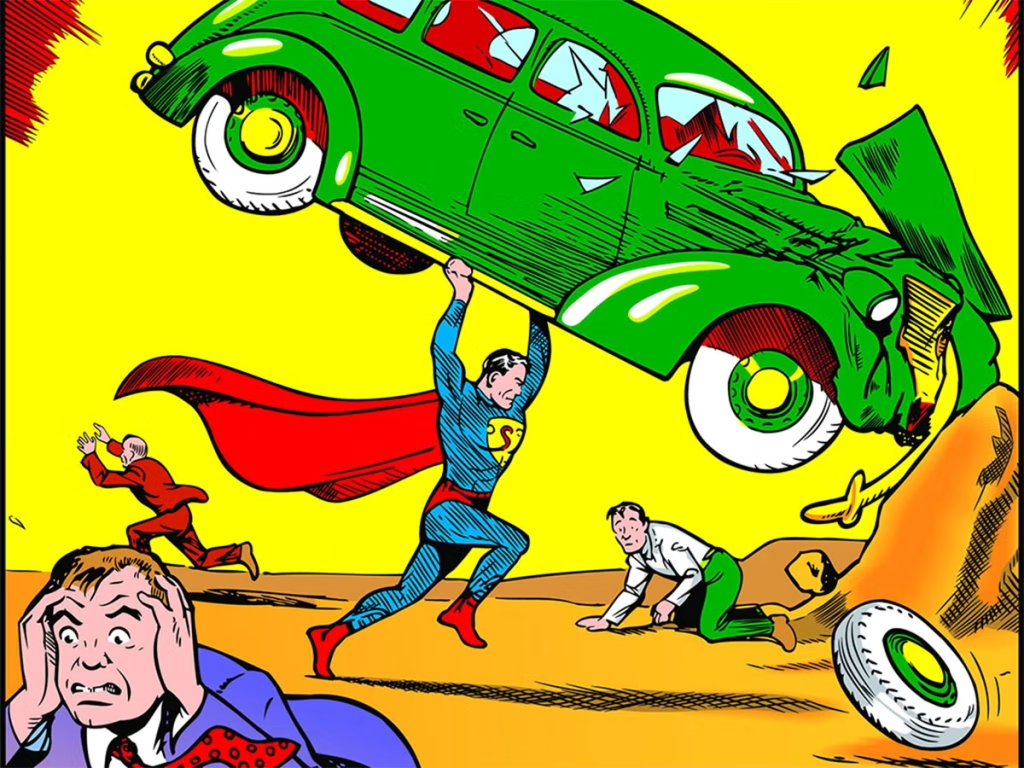
Far ahead of the curve in standing against Adolph Hitler and his Nazi goons were Joe Simon and Jack Kirby. The cover of the first issue of Captain America featured a man wrapped in an American flag punching Adolph Hitler directly in the face. To add insult to Hitler’s injury, Captain America was not only unabashedly anti-Nazi, he was a blond-haired Adonis-like figure, one of the ideal pictures of humanity and masculinity that Hitler believed was superior. Much like Greenbaum, Simon and Kirby saw what was happening and decided to do something about it.
In 2024, Madison Square Garden was home to another buffoonish leader who wanted to stir up the crowd with violent and racist language, hoping to make a direct connection between the 1939 Nazi rally and current feelings of hatred towards several out groups. This is not just my opinion. Leading scholar, researcher and historian who specializes in understanding the authoritarian play book Ruth Ben-Giat also believes there is a direct comparison between the two events.
The Bund rally was exposed for what it was by a single man taking action. Yet the MAGA rally attempted to work on two levels. First and foremost, it was a dog whistle to anyone who truly believed in the racist component of the America First, isolationist, anti-immigrant policies Trump would go on to enact. Secondly, it operated as a mechanism of attempting to discredit anyone trying to condemn this rally as being anything like the 1939 rally. It was not technically held in the same structure, as Madison Square Garden had been rebuilt in the intervening years. This rally didn’t require any kind of formal membership in an organization for someone to be a speaker. There were not uniforms for everyone onstage. However, most of the audience members were wearing the same red hats.
If someone on the left mentioned this was a hate rally, the MAGA movement attacked back by stating they were “trolling the libs” or saying they were offended to be compared to the hateful groups of the past. Yet the language used there reflected much of what the American Bund was saying in 1939. One speaker at one of the rallies said, “America is for Americans and Americans only.” A speaker at the other said, “…restore America to the true Americans.” Without looking it up can you tell which one came from which rally? They are both anti-immigrant, American isolationist statements. And Ruth Ben-Giat’s comments on Trump trying to normalize violence and violent rhetoric have become disturbingly prophetic. One only needs to view how certain television networks defend any kind of violence against immigrants, protestors, or anyone else MAGA hates to understand how this has taken hold.
To bring this back to Captain America, he was in part inspired by the rally in 1939 as well as other pro Nazi news and sentiments that continued in the following years. And today, in 2026, this character would still punch a fascist in the face. That has never changed. If it was as simple as standing up to bullies, Cap could already teach us a lot. But, Captain America has never been the perfect vehicle for delivering anti-authoritarian messages. In fact, we can learn much from the creator’s mistakes as well as from the successful actions of Steve Rogers and other characters who have taken on the mantle of Captain America.
The Early Days of Captain America
If you look at the earliest issues of the comic book you will find lots of war stories, plenty of action, a superhero ready to defend his country along with his young counterpart Bucky Barnes, and far too many racist depictions of anyone who was not white. Especially bad depictions are made of Asian and Black characters in the book. While fighting the Nazis was and remains a laudable goal, the book is filled with jingoism from cover to cover in the early days. The book never really addressed things like Japanese-American internment camps in the country, nor did it provide any nuance to the evil bad guys. Which, in part is fair. Nazis were and are evil. It’s probably not up to a comic book like Captain America to convince us how normal people can be swept up in the atrocities that came out of World War II.
It’s also important to note that the creators of the book didn’t only make comics. They themselves served in the war. Jack Kirby even had a hand in helping to free people imprisoned in a concentration camp. Because of his artistic skills he was often sent out to scout ahead and draw maps of locations. He was a valuable asset to the war effort and he was fighting fascism before it was cool and he still helps us to do so now. The character he created has had an immeasurable impact on the fight against authoritarianism. Unfortunately, because he is draped in the American flag, sometimes those same authoritarians try to claim this character as being on their side. He is not, has not ever been, nor ever will be on the side of fascist ideals.
Early mistakes aside, Captain America has always fought not for what America is, but what it could be. Steve Rogers was experimented on and became the first super soldier. Immediately after, the man who developed the serum was killed by German spies. This makes Steve Rogers a uniquely American hero in the Marvel universe. But he does not become an instrument of the government. In the earliest issues he fought the good fight during the war. He was part of the military so he did work for the government in that way. But that never meant he had to fully comply and agree with everything our government did.
Captain America Reborn
There are two basic phases when it comes to Captain America the comic book. First, the war phase. G.I.’s in the actual war would receive care packages and they were often filled with comic books. Captain America for obvious reasons was one of the most popular titles. This continued through and a little after the war. But by 1949 the book felt less relevant and Cap had his first hiatus. He disappeared from newsstands until 1953 when he was brought back to fight the “commies” for a while but it was short-lived and the title went away again in 1954.
The main phase of Captain America, the one we all know and recognize now actually debuted in Avengers #4 in 1964. Stan Lee brought him back by explaining that Steve Rogers had been frozen in ice for 20 long years. Because of his super soldier serum he was able to survive and went on to be one of the most important, recognizable, and powerful superheroes of the Marvel age. In the MCU this gets extended to match our current timeline showing him as frozen for 66 years in the films. I suspect this will continually get recontextualized because the character simply works best if he is a man out of time who is trying to understand our current era.
From this rebirth of the character is where things get interesting with Steve Rogers. He always sticks up for others, he’s a good leader because he empathizes with everyone, and he’s willing to make his voice heard whether the government thinks it is a good idea or not. In the 1970’s during the height of the Watergate scandal the book heavily implies but just doesn’t quite show all the way that Steve opposed corruption in the White House. Just like he would now. This story was Captain America #169–175 (“The Secret Empire”). And it remains one of the greatest Cap stories of all time.
In fact, Steve Rogers sticks to his principles so much that he is willing to walk away from his own title in the story The Captain (#332–350). Written by Mark Gruenwald, this story shows what happens when he refuses to become a weapon for state authoritarianism. Steve gives up his uniform and shield, operating instead as an independent hero named “The Captain” while a violent, state-sanctioned replacement takes his place. You can see where the conflict comes from with that one.
In 2005, Ed Brubaker had a legendary run on Captain America where he brought back Bucky Barnes as The Winter Soldier. In that story, a corporate-fascist executive named Aleksander Lukin weaponizes elements of the U.S. military-industrial complex and S.H.I.E.L.D. from within. It highlights how easily bureaucratic institutions can be subverted by totalitarian interests. Which is exactly what we see now when we see that the Trumps invest in drone companies and then those drones are literally used to kill people in wars we had no business starting. It’s all done for control and profit.
Another notable instance of Steve Rogers fighting against the status quo was the events of Civil War. This story doesn’t tie directly into fascism in America, but it does show that Steve will stand on principle over orders. For this story, I strongly recommend reading the comics over watching the movie because the film loses most of the nuance that gave meaning behind Cap’s actions.
While I could continue listing stories that involve Steve Rogers and are great starting points for fighting fascism, there are two recent stories that highlight the worst and best ways to fight fascism. The Secret Empire remake was a backfire of epic proportions while Truth: Red, White, & Black is a masterclass in recontextualizing and adding to the rich history of comics that shows us knowing history is vital for fighting against authoritarianism.
The Secret Empire Remake Debacle
One of the fascist institutions in Captain America comics right from the first issue was Hydra. This is an evil organization run by Nazis and headed by the evil Red Skull. Think of him as the Joker to Steve Rogers’ Batman. In the 1970s the creators of Captain America had the foresight and integrity to call out what the American government was doing and force Steve to confront the implications of a corrupt White House. This is one of the reasons it is considered amongst the best Captain America stories ever told. It’s no wonder there was an attempt to remake this in 2017. But the creators of the modern series made huge mistakes.
Remakes, rewrites, and re-imaginings are frequent in comic books. Sometimes they provide new context, sometimes they revitalize a forgotten character, and sometimes they are better stories than the originals. 2017’s Secret Empire was none of that. This is where we get the Nazi Steve Rogers. It was supposedly not an alternate reality, not a dream, not anything that could easily be waved away by a writer. In the story the creators reveal that Steve was, and had always been, part of Hydra. Pushing the envelope in comic books is good. But shocking for shock value when it comes to fascism? Well, that was a mistake. Readers did not take kindly to this version of Captain America and for good reason. We could all see what was happening with the Trump administration. Even in the first term they were restricting travel, caging families, and becoming more isolationist than is healthy for any country. To have a symbol like Steve Rogers suddenly side with people like that? It tore at the hearts of comic book readers in a way that felt unforgivable.
As I am sure you can guess, if you read comics, there was a long and complicated route that brought back our beloved Steve Rogers. We still, now, have the man who will fight Nazis, not be one.
This story was also counter to the depiction of Steve we see in the films. He does watch Hydra surround him in some of those movies. The organization penetrates S.H.I.E.L.D. from within but Steve himself? He is on an elevator and watches several of these agents get on with him. He knows what is coming and he just lets them keep loading up the elevator. He not only fights his way past them while inside of a crowded elevator, he beats the hell out of them so they will never forget who stood up to them. He goes on the run from the government until he can clear his name. He fights Iron Man, one of his closest allies, just to stand up for what he believes in. And in Chris Evans’ depiction of the character is where we get one of the most memorable lines Captain America ever says. He gets knocked down over and over both physically and metaphorically. But what does he do? He stands back up and says, “I can do this all day.”
It was a strange whiplash to have that character on film while in the comics he was saying, “Hail Hydra.” As far as the mechanics of the story, it was a solid foundation but the timing and the execution were simply terrible. And it made readers who love the character walk away from him.
If you left the books because of that, I can tell you it is safe to return because we do have the real Steve back now. But if you can’t forgive it for taking an icon of independence and even temporarily turning him into a fascist, well, I can’t blame you either.
One thing to note about Captain America whether we are talking about the comic books, the movies, or almost any other iteration, is that these stories are told from the white, straight, American male perspective. Steve surrounds himself with people from all backgrounds and to those of us, like myself, who share Steve’s ideals and skin tone, we should remember that he has a whole team around him who help him to succeed. He cares about all of them but sometimes, he must be the one to speak because those with less representation are often not heard. It’s why having this white, blonde, American man punching Hitler in the face was so effective all those years ago. We might look like some of these fascists but that sure as hell does not mean we agree with them.
But there is one incredibly impactful story that was told from a different perspective and is simply incredible in the delivery is Truth: Red, White, & Black.
Truth: Red, White, & Black
You’d think after decades of comic books about Steve Rogers there wasn’t anything new to learn. But in 2003, we got one of the most impressive Captain America stories ever and it had almost nothing to do with Steve. Written by Robert Morales and illustrated by Kyle Baker Truth: Red, White, & Black tells the story of a group of black soldiers who receive early versions of the super soldier serum that worked on Steve Rogers.
The difference? These men didn’t volunteer to become a superhero. No, they were experimented on and used by their own government even as they were trying to fight for freedoms they never fully enjoyed at home. It mirrors the real life events of the Tuskegee Syphilis study where 399 Black sharecroppers who had Syphilis were told they were being treated for their “bad blood.” This was done simply because the government wanted to see what would happen if they let the disease play out without real treatment. The government could have cured these men but chose not to. It remains one of the most shameful incidents of American history and if you don’t know about it, look it up before this administration erases all the records of it.
As far as the comic goes, this group of black soldiers is injected with the serum. Several of them die immediately. The white officers show no compassion for these soldiers and the experiments continue. Eventually, a few do survive the process. They end up with super strength but they also look like mutated abominations as a result. Soon, most of them die as well as the long term impacts of the serum are not yet understood.
Finally, one soldier seems to take well to the serum. His name is Isaiah Bradley. And if you go by his timeline, he’s technically the first Captain America despite the fact that Steve Rogers is making appearances in his uniform in the U.S. at this time. And Bradley is assigned a mission from hell. He is tasked with liberating a Nazi death camp. He’s supposed to go with Steve Rogers who is unable to show up through no fault of his own. Bradley decides to take the uniform meant for Steve and free the people in the camp. He is successful although he can’t save those who died already and those who are too near to death to make it for long.
And there’s a heartbreaking scene where a fair number of people die as Bradley, try as he might can’t save them and he himself is captured by Germans.
One would think that a war hero of that caliber would return home to a grand welcome with a parade and a celebration. Instead? Bradley is court-martialed and imprisoned for 17 years for stealing the uniform. Steve Rogers has no knowledge of any of this. And because of the effects of the serum, Bradley is mentally compromised and in a very sorry state when Steve does finally find out about the “Black Captain America.”
The story is moving and does not shy away from the atrocities of war, of American government, from institutional racism, and it still allows us to know that fighting fascism is worth the effort. It doesn’t try to hide or change history the way this administration wants to. It shows the flaws of America and the strengths. It’s a story that without ever saying it explicitly allows the characters to get knocked down over and over just to get back up and say, “I can do this all day.”
This is why we need to fight to preserve all of our history, not just some of it. When we find out new information that we didn’t fully understand, we can acknowledge there are good fights to be had that sometimes we execute poorly. The main thing we have to do is not lose hope. We all need to be able to do what both Isaiah Bradley and Steve Rogers did. We might take some punches. We might get knocked down. Sometimes, we even pick the wrong fight. But as long as we are fighting against fascism? We’ll get back up again and punch a Nazi in the face.
How We Can Learn From Captain America
It’s not always easy to know what to do when you are confronted with true evil. I grew up thinking people with fascist ideas were far off somewhere in the past, already dealt with. But now, when I see things like the rally at Madison Square Garden, when I hear people like Stephen Miller, as I watch ICE capture, beat, and kill citizens and non-citizens alike, I know that was a false version of reality. Fascism is here and now in America.
It’s trying to gain strength. It’s trying to amass crowds and overrule those of us who think, look, or are different. Fascism is in our headlines every single morning now. And the media companies keep falling prey to the idea of capitulating to authoritarians. They should remember how well that worked out for those who surrounded Hitler. It was not a kind end for any of them.
There are some things we need to remember. First, the idea of reading, making, and sharing something like a comic book with an anti-fascist message scares the hell out of these people. And for good reason. Comic book fans are a community. We talk to one another. We share common interests and most of us understand the subtext of what we read. This makes us more educated than the Trump administration would like us to be. When you read a Captain America story, especially one of the great ones, you are committing a small act of defiance against this regime.
Second, let’s remember not to give up hope. Steve Rogers doesn’t. Isaiah Bradley had every reason to but he doesn’t either. Even when Steve leaves his uniform behind, he’s still fighting for what this country could be. He sees those Hydra agents and welcomes them to the elevator and gives them a chance to change their minds before he beats them down.
But the biggest lesson we get from Captain America isn’t even the line from the movie, “I can do this all day.” It’s what you watch him do when he says it. Captain America stands up. Every time. He stands up when they knock him down. He stands up for others. He stands up for freedom. He stands up to fascists. And yes, he punches them in the face and does not apologize for that.
Remember to always stand up for what is right, even when it feels hopeless, even when you are running out of steam. They are afraid of anyone willing to get off of their knees.
Recommended Reading for Captain America
Marvel Unlimited has all of the Captain America comics you can read except for the most recent three months. Below are my recommendations for the greatest Cap stories of all time for fighting fascism.
Captain America Comics #1 (1941) – Steve Rogers punches Hitler in the face on the cover and this starts the whole thing.
Captain America #193–200: The Madbomb – Jack Kirby returns to the title and tells a story about a secret society of wealthy elites who plot to overthrow the U.S. government on the Bicentennial. They use a device called the “Madbomb” to strip citizens of their free will and reduce them to a state of mindless, violent rage. It remains one of the ultimate allegories for how fascist structures exploit chaos to seize power.
Captain America #247–255: Dawn’s Early Light – This run features Steve Rogers facing off against Baron Blood and his arch-nemesis, Baron von Strucker. It shows Captain America’s definitive ideological rejection of fascism, emphasizing that true patriotism means defending the freedom of all people, not blind obedience to a state or dictator.
Captain America: Sam Wilson (2015) #1–6 – Sam Wilson (aka the Falcon acting as the new Captain America) takes up the shield, facing a resurgence of the Sons of the Serpent, a fascist, white-nationalist militia operating along the US-Mexico border. Written by Nick Spencer, this run explores how modern fascism wraps itself in corporate messaging and internet culture, testing what the shield stands for in a deeply divided, modern landscape.
Captain America #1–14 (1998): Heroes Return – Written by Mark Waid, this run features a storyline titled “Man Without a Country.” The Red Skull uses a reality-warping Cosmic Cube to trick the world into thinking Captain America has turned fascist, resulting in Steve being exiled from the United States. It is a brilliant examination of how easily nationalistic fervor can be weaponized and manipulated by fascist propaganda.
The Secret Empire (#172–175) – Written by Steve Englehart, Cap discovers a fascist shadow group has infiltrated the highest levels of the White House. The storyline ends with the villainous mastermind committing suicide in the Oval Office. The shock causes Steve Rogers to temporarily abandon the Captain America identity entirely.
The Captain (#332–350) – Written by Mark Gruenwald, a corrupt government committee demands Cap report directly to them and follow political orders. Refusing to become a weapon for state authoritarianism, Steve surrenders his uniform and shield, operating instead as an independent hero named “The Captain.”
Winter Soldier / The Red Menace (#1–14, 2005) – Ed Brubaker’s legendary run shows a corporate-fascist executive named Aleksander Lukin weaponizing corrupt elements of the U.S. military-industrial complex and S.H.I.E.L.D. from within. It highlights how easily bureaucratic institutions can be subverted by totalitarian interests.
Civil War (2006) – The U.S. government passes the Superhuman Registration Act, turning the country into a surveillance state that strips citizens of due process. Cap refuses to enforce the law, leading a underground rebellion against his own government and former allies.
Truth: Red, White & Black – Written by Robert Morales and illustrated by Kyle Baker, this groundbreaking historical fiction series unearths the tragic secret history of the Super-Soldier program. It serves as a direct comic book allegory to the real-life Tuskegee Syphilis Study.
Next up on Comics for Fighting Fascism: Persepolis