Comic Books for Fighting Fascism – Maus

Cover of Maus I by Art Spiegelman

This series of posts was inspired by the Popsmart Instagram series Films for Fighting Fascism by Professor Shannon Mancus. She’s much smarter than I am and has more degrees than I do but I bet I’ve read more comics than her.

Maus is a Masterclass in Narrative Storytelling

Maus by Art Spiegelman is a personal narrative about Art’s father Vladek who survived the Holocaust. It’s also a deep personal reflection about Art’s relationship with his father. It’s a story that does not flinch; it does not compromise, and although it is obviously fictionalized, it tells the truth in a way most historical accounts can’t. And it gives us a powerful tool for fighting fascism. At the end of this article, I’ll give you five words capable of kneecapping some of the worst tendencies in authoritarian regimes.

But first, let’s talk about the most obvious differentiator of this narrative from any others. Art Spiegelman’s brilliant stylistic choices. In the story Jewish people are depicted as mice, Nazis and other Germans are depicted as cats. There are a few other animal metaphors and choices in the art but the cat and mouse dynamic is the most significant. On the surface this seems simple. Nazis are predators and Jewish people are the prey. But this is also a personal connection to Vladek, the main character. For several years he plays a cat-and-mouse game of life and death with the Germans. Vladek is sometimes able to hide or blend in because, despite the nonsense of what Nazis think, it is not obvious on the surface if someone is Jewish or not. And he has certain resources and connections that help him to survive. Yet, even though we know his survival occurred, the story shows how random it was as far as who did and did not live to tell their own stories. His survival is one of allocating resources, relying on his strength, understanding when to bargain with someone, and sheer luck. There is not one thing in particular we can point to that lets us understand why Vladek survived while so many others did not. Early in the narrative it is easy to say he survived because he had more wealth and resources than others. But as everyone is stripped of their power, first slowly, then shockingly rapidly, access to those original resources matter less and less.

As the story unfolds, and things become worse in Poland and other places Vladek is in, we see occasions where there are Germans who are not Jewish caught up, executed and mixed in with the mice. There is even a point where Art changes the drawing of one person from a mouse to a cat in the camps. Vladek is not sure but he believes this could have been a German who was not Jewish. This again goes to show how ridiculous the Nazi ideas of racial superiority were. And the narrative doesn’t back down from showing terrible things people forced into the ghettos and camps did to one another. Nor does it back down when the narrative shifts to the present and we see certain prejudices that Vladek himself has.

The creator of this comic book did not have to choose to draw everyone as animals. And in fact, there are times when he shows people wearing an animal mask rather than being simply a mouse, cat, pig or any other animal. No medium other than comics could have pulled this off so well. Yet the drawings are largely simple. When the art does make a visual statement, when it goes into graphic detail, those panels pack an undeniable punch. It does not matter that we are looking at cats, mice, pigs, and dogs. We know these are humans. Add to that the fact that the first tool of fascists is to dehumanize any group they don’t align with until no one is human and the structural significance of the metaphor clicks into place. It’s an absolutely brilliant artistic choice that no one but an independent comic book creator would dare to make.

It helped that Spiegelman was already an independent undergound comic book creator before he started making this. It helped him to think outside of the box that we find in dry historical records. For whatever reason, this choice works so perfectly and the story is told so well that Maus won the Pulitzer Prize. It’s even become an educational tool teachers often use to convey the real horrors of what humans are capable of.

Visual choices are not the only thing that make this work a masterclass. If you read Maus, there is one word that describes it better than any other. Honest. The title of part one, My Father Bleeds History is about as honest as you can get. Vladek tells his story in vivid detail and the story jumps to life on every page. We do see Vladek bleed in the flashbacks to what was happening leading up to and during the Nazi takeover of Germany and Poland and we see him pour out his history to his son. We can even see some of the psychological trauma that likely lingered in Vladek because of his experiences.

At the same time, Art has a complicated relationship with his father. We see this from the narrator’s perspective and even see panels where Art struggles with his own decisions about this project. It adds a layer of honesty to what was already a gripping story. Through Art’s eyes we can wonder if some of the traits Vladek has are because of his trauma or just because of who he is. There is no obvious answer to this question, nor should there be. People, even people who have experienced the worst of humanity, are complicated. There is one point in the narrative where Art reflects on his older brother who died years before he was born. He implies he has a sibling rivalry with a photograph. This is such a complicated dynamic through no fault of Vladek’s or Art’s yet it is a significant reminder of the lives that have been lost. Trauma is passed on generationally in these situations, leaving victims not only in the past but also in the present. This is why narratives like this are so incredibly important to share.

Another way to tell this story has significant meaning is by how often it has been banned. Fascists hate true things. They also hate historical context. And they hate art.

Some people might argue that fascists have their own forms of art. There were Nazi films, books, literature, etc. This was propaganda and while it has the veneer of art, it is not true art. Much in the same way we can look at an AI generated image and understand it is not true art, if you look at the posters, flyers, films and other types of media forced on the public by the Nazis, it is clearly hollow and has no true artistic vision behind it.

Maus is honest art. And that terrifies fascists. For that reason alone, you should read it.

Fascists Are Trying to Suppress Art and History Right Now

Whether you want to call the Trump administration fascists, authoritarians, oligarchs, kleptocrats or something else is irrelevant. They are enacting authoritarian policies that align far too well with the Nazi regime right now. They have spent years dehumanizing immigrants, black people, gay people, trans people, and anyone else who doesn’t fit their ideal of perfection. Just like in Nazi Germany, this government now is telling the populace there is someone to blame for your troubles. It’s not your fault, it’s not the system’s fault that you are struggling, look over at this out group who we can all blame. Why do they do this? So that when they start censoring history, when they build concentration camps, when they kill humans, you will not think of that group as people. No. To you they are mice, rats, or whatever label they want to give them other than a person. This is the goal of fascists. And there is concrete evidence they are doing this now as you are reading this article.

There are already examples of exhibits in the Smithsonian being removed by the Trump administration. They want you to believe that anything they deem “woke” is bad. This is such a catch-all term that it has resulted in the removal of references to the aircraft the Enola Gay from Pentagon documents. This aircraft is one of two that dropped atomic bombs on Japan. It may be one of the most insane removals of history ever recorded. Yet the fascist regime claims they are only targeting “woke, DEI” policies. What does this have in common with Maus? The Nazis also used overly broad terms like “jew businesses and ideas” to justify committing violence against anyone they wanted to target. They are intentionally non-specific about what it means to be “woke” or “DEI.” And as people in Nazi occupied territories eventually came to realize, if you end up dehumanizing out groups long enough, you end up in one of the out groups that gets targeted.

No one wanted to believe the things they were hearing in Poland in 1939. Some people thought it would be best to work with the Germans to help round up Jewish people. Many of those people who did the rounding up also found themselves in the camps by the end. Often in the narrative of Maus Art asks Vladek what happened to certain people who helped the Nazis. Not every time but several times, Vladek says they also died in the camps. Some of the people who helped Jewish people were also killed. And there were others who did bad things yet survived. There were Holocaust deniers during the Holocaust because they didn’t want to believe humans could be so cruel. There are Holocaust deniers now because they don’t want you to know the truth behind history. They are terrified you will learn from it.

What the fascists of today want you to believe is that the Holocaust was not the way Spiegelman depicted it. To them, this is over, settled history, and we should move on. That’s because they want you to forget that Hitler at the start was seen as an over-the-top weird politician with odd ideas who they could ignore. They want you to forget that he then gathered a collection of other weird people with weird ideas and using a system that was broken, they set themselves up for power. This is exactly how we ended up with the current administration in America.. No matter what you think of people like Elon Musk, Donald Trump, and R.F.K. Jr., I doubt you would describe them as “normal.” And before you accuse me of overstating the facts, or exaggerating the horrors of this administration, let me remind you, we have concentration camps in America right now.

I’m not claiming this as an expert on concentration camps. Heather Cox Richardson, a noted American historian, has explained that these are, in fact, concentration camps. She has a fascinating historical record on her Substack titled Letters From an American and she consistently puts things into perspective on her YouTube channel. She has consistently explained not only the horrors of what is happening now but reminded us that a concentration camp is a place where you concentrate a large number of people. The immigration detention centers in this country qualify for the term. If that was not bad enough, the people in those concentration camps are being mistreated, undernourished, beaten, sexually assaulted, and sometimes outright killed. The administration wants you to think of those people in those facilities as non-humans. That way you will not be upset when a sitting U.S. Senator is pepper sprayed in his face as he goes to support the people protesting there. These are the same fascist tactics the Nazis used. And you can understand the parallels if you read historical narratives like Maus.

This is why Maus itself has been banned so often. And the reasoning given for trying to suppress such a narrative is beyond ridiculous. The book has been banned for having ‘explicit’ language. It has the words goddamn and bitch in it. For those on the right who are always going on about how much they hate censorship, it makes no sense to ban Maus based on the language. Our own president has used much more explicit words while giving public speeches. Another ground on which this is challenged is for nudity. There is one picture of Art Spiegelman’s mother in a bathtub after she committed suicide in which if you look very, very closely, you can see her breasts. In my opinion, only someone weirdly obsessed with genitalia is even trying to look at that. The final ground on which this book has been challenged is somewhat more valid but it requires nuance and context. This is deep subject matter and the themes in the book are obviously very dark. I think there is a discussion to be had about at what age it is appropriate to allow children to read this narrative. But as always when it comes to this question, there is one simple answer. It depends on the child. Some kids in middle school can handle these types of stories while others cannot. But certainly by high school children can understand this narrative. And it can help them to understand their own world. Fascists can’t stand educated children.

While I think it’s wholly unjustified to ban Maus, I don’t want you to worry about Art Spiegelman. He’s an extremely successful creator and banning his book tends to lead to more sales for him. What does concern me is other artists who are being banned that we are less aware of. I’m not going to tell you to go out and buy Maus right now (although I will provide a link if you want to). What I do think you should do is go check at your local library, your school library, or your local book store and find out if it has been banned there. If so, start a petition to request it be returned to the shelves. If we can prove that we can bring back books that have been banned, those lesser-known creators will have more room to express their narratives.

Now, let’s talk about the five words I have for you to use to fight fascism.

Write It Down. Create Art.

Vladek Spiegelman did not want to tell his story. Thankfully, Art Spiegelman did. He did it masterfully too. Vladek’s wife Anja wrote a series of diaries about her life. Unfortunately, Vladek, at some point, threw them out after her death. In the panels of Maus you can see how troubling this is to Art. It was an entirely different perspective on these events that he could not access. While Vladek’s story is essential historical reading, who knows how powerful those diaries could have become in the hands of someone like Art? We’ll never know.

I don’t think Vladek would have described himself as special, nor would he have described his wife Anja as special, except that they loved one another. Yet this narrative about a normal person living through the most horrific events imaginable imprints an indelible record on the collective conscious.

Right now there are children who have been housed in concentration camps in America. Some of them are going to grow up with stories to tell. They are going to explain to their children what happened to them. Right now there are people who are protesting these injustices in the streets. Already we know some of them will not be able to tell their own stories as their lives were cut short. Right now there are people being fed meals filled with worms in detention centers in America. These are not things that have happened in the past, these are things happening at this moment. We have YouTube, TikTok, cell phone videos, news reports, and articles explaining what is happening. We have political pundits trying to spin these events as normal. We have other pundits pointing out the true horrors. These are important things to have. But we also need people to write it down. We need people to make art. We need you to tell your story. We need you to make your art. I don’t care if you’re just an average, everyday, normal person. Ruth Ben-Giat, another noted historian, in her book Strongmen, mentions that simple, everyday acts of defiance can contribute to the toppling of an authoritarian regime. This can include personal stories. And it includes art.

If you know someone who has been taken by ICE or who has been fired by the administration because of their “anti-woke” policies, write it down. Make art out of it. Even if you don’t it can help to just record how you are feeling about things today. Eventually someone may read it and it might make a huge impact on the collective conscious like Maus did.

I’ll admit I have tried to keep a personal journal for years. I almost always end up abandoning it. Your art does not have to be a personal narrative. We still need your art. Not AI generated art, but personal, human art that can reach us. Even if it’s simply a romantic fantasy, we still need it. We need musicians, artists, and every type of creator to continue to make art. And if you’ve never tried it, now is the time.

For me, this series of blog posts is my version of writing it down. While I am no artist and I am not good at creating visual art, I do know comics. I read them all the time and I have done so since I can remember. I can see what is happening today and see how it relates to what I have read in said comics. I don’t know if anything I write will ever make an impact to anyone. But I feel the need to share it either way. And I want you to do the same. Whatever that looks like to you, I want to see it. And someone else is going to want to see it as well.

If you have an anti-authoritarian streak in you, write it down. Make art. The fascists hate it when you do. And to me that is more than enough reason to do it.

Where to Find Maus

Please check your local library or book store to see if they have a copy. It’s not easy to find digital copies but the book is in print everywhere. The best version to read is called The Complete Maus and it contains Maus I and Maus II which were printed as separate books.

In case you can’t find it, I do have a link to it from the Internet Archives here. But, like I said, please check your closest library first.

Next Time

My next post in this series will be on Captain America.

Captain America #1 by Timely Comics

Comic Books for Fighting Fascism – Superman

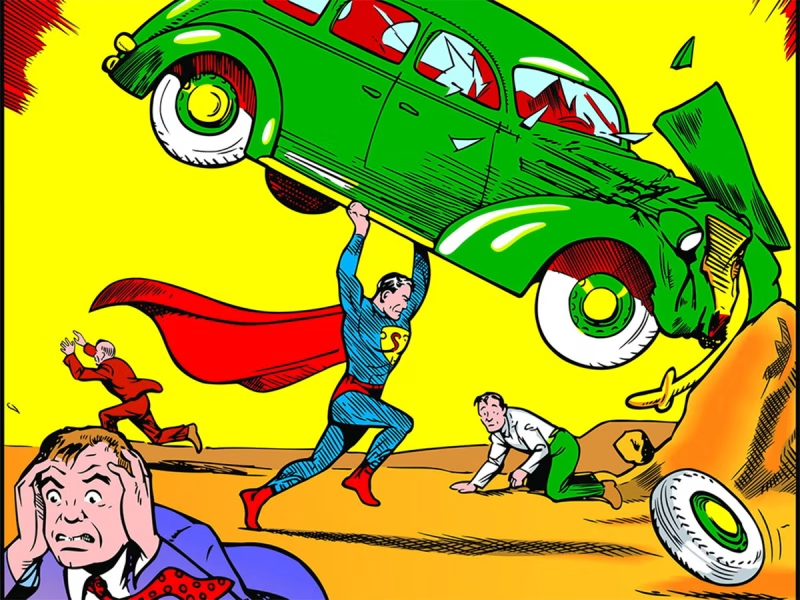
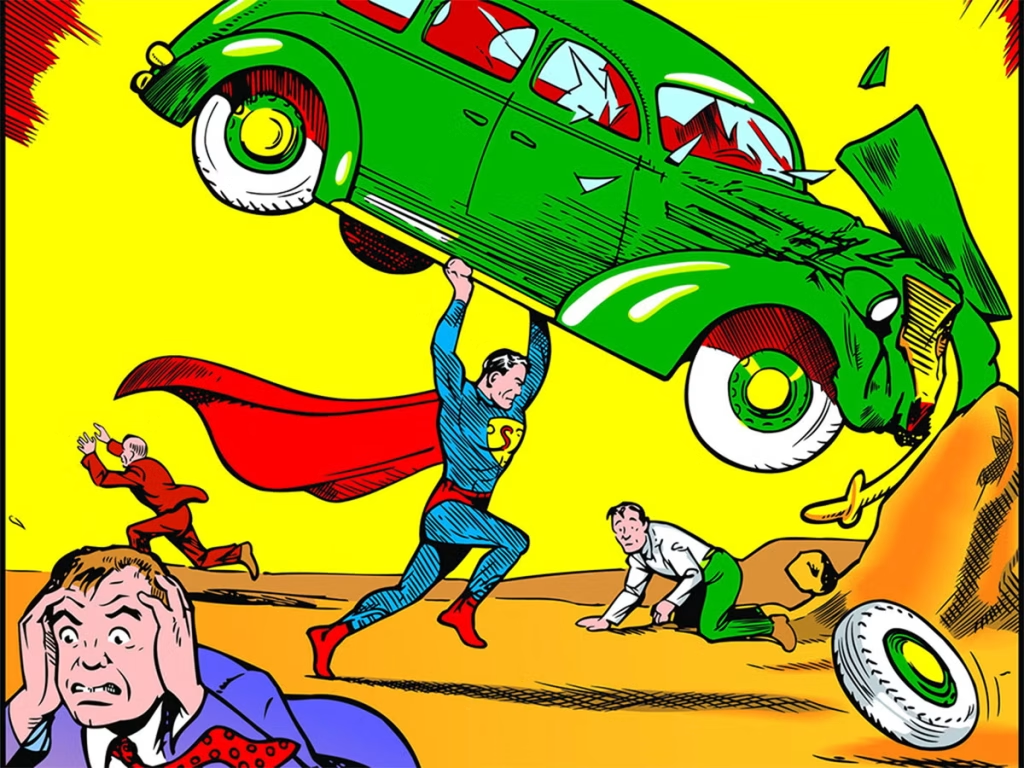
Cover of Action Comics #1 by DC Comics

This series of posts was inspired by the Popsmart Instagram series Films for Fighting Fascism by Professor Shannon Mancus. She’s much smarter than I am and has more degrees than I do but I bet I’ve read more comics than her.

The Creation of Superman Fought Fascism

In 1938, two Jewish men from Cleveland debuted a character in a comic book titled Action Comics #1. Jerry Siegel was the writer and Joe Shuster was the artist. At the time, in Germany, the Nazi regime had bastardized the concept of the Übermensch from Friedrich Nietzsche to justify racial supremacy. The two comic creators subverted this idea and named their character Superman. It was an obvious attempt to redefine what might be considered “superior” in the minds of the world.

The creators imagined someone strong enough to stop evil the moment the hero sees it. Superman was built to defend the most vulnerable. He is a protector who sides with the underdog, fights tyranny, and stops corruption.

The Nazi party actually noticed this subversion. In 1940, the official SS newspaper, Das Schwarze Korps, published a vitriolic attack on Jerry Siegel, calling him an “intellectually and physically circumcised chap” and mocking Superman as a Jewish fantasy. The creators’ act of creation was so powerful it drew direct fire from the Third Reich before America even entered the war.

To even entertain the notion that Superman would kowtow to an authoritarian regime, or any government with strict dictates against freedom of thought and expression is farcical on its face.

Yet even today there are those on the political right who claim that Superman is meant to be a stoic character, god-like, who is not only physically but emotionally invulnerable. One who would never crack a smile, cry at the death of a loved one, or become angry at the United States government shooting protestors in the streets. The premiere issue of Action Comics debunks all of that.

In his first comic, Superman fights corrupt politicians, domestic abusers, and corporate fat-cats. In essence, Superman was a New Deal Democrat right from the start. He was seen as the hero who could put a halt to fascism, not one who might uphold it. He didn’t start with god-like powers either. Yes, he was stronger than the average man and invulnerable to bullets. But there were limits. He could not yet fly. He could take large leaps. He could lift cars above his head without trouble. Yet there was no indication his strength was limitless. Nor has there ever been the indication that Superman can’t be hurt, bleed, or even die in all of his long history.

While acting stoic and showing no empathy at the suffering of others from authoritarian aligned people might on the surface look “manly” and hero-like, it is not. That is just performance. One of the first and most crucial tools of tyranny is to dehumanize others. The only way to do that is to remove our empathy for one another. To remove our community and act as if we don’t feel the pain of those in need is the goal of all authoritarian regimes. Often that starts by encouraging hypermasculine attitudes as if showing emotions is a weakness rather than a universal human experience.

Superman is a true hero to and for the people. He’s an immigrant from a dead culture who sought refuge in America. Upon arrival he immediately began contributing to society and helping people. Rather than seeing humans as alien in his Kryptonian view of the world, he strives to become the most human amongst us.

Superman Continued to Fight Far Right Agendas Long After Action Comics #1

In comparison to other comic book characters of the World War II era, Superman was a little slow to join the fight in an overt manner. But when he did join the fray, it happened even before Captain America famously punched Hitler on the cover of his 1940 debut. Instead of a standard comic issue, the creators of Superman published an imaginary story in Look Magazine depicting how the hero could end the war. It might have been more bold to put the story into Action Comics but it was still a poke in the eye of the Nazi regime. But his fight against those with ridiculous ideas of racial superiority didn’t end there.

Just after the war, Superman was hugely popular and had his own radio show. In 1946, the Adventures of Superman radio show ran the “Clan of the Fiery Cross” storyline. Activist Stetson Kennedy had infiltrated the KKK, learned their secret code words, rituals, and hierarchy, and passed the information to the show’s producers. By exposing the Klan’s ridiculous secret handshakes and titles on a massive children’s broadcast, the show stripped away the mystique and terror of the group. It humiliated them, destroyed their recruitment numbers, and mobilized the community against them.

Gene Luen Yang, a Bay Area comic book creator best known for American Born Chinese, has a fantastic and fascinating graphic novel loosely based on the Clan of the Fiery Cross storyline titled Superman Smashes the Klan. Written in 2019 the book proves Superman is as against hatred now as he has ever been.

In Action Comics #900 (2011), Superman actually renounced his US citizenship because he was tired of his actions being used as political policy by the US government after he walked with peaceful protestors in Iran. While some on the right viewed this as being un-American, Superman was exercising one of our most fundamental freedoms as Americans. The right to peacefully assemble. A right the government in Iran is still suppressing even now. Superman, at this point, realizes that even American government can be led towards authoritarianism and he is a symbol more meaningful than any single government. As our own government shoots protestors, it is reassuring to know if Superman were real, he would be in the streets protesting with us.

Absolute Superman is a current title featuring an alternate universe in which Superman is directly confronting billionaires, using his empathy to try to understand the world today, and taking action. Again he displays radical empathy. He’s intensely affected by the pain and deaths of those around him. The most current iteration of the character is still doing what he did in his debut comic.

The act of reading these stories alone is a tool against fascism. These stories teach us that the most heroic of heroes is one that feels emotional depth, understands those in need, and then does something about it. No matter the cost to himself. Yes, he is physically invulnerable to most things. However, losing one life of any human is more devastating to Clark Kent/Superman than dying from kryptonite poisoning.

Some people have criticized the most recent film adaptation of the character as showing him being too kind. With Superman that is literally impossible. His whole character is radical empathy and meaningful kindness. And his hope is to spread this kindness to the world.

Superman Creates Community

By DC Comics – DC Comics, Fair use, https://en.wikipedia.org/w/index.php?curid=78165388

If you look at the long history of the world’s most famous superhero you will see that he believes in hope for others so strongly he himself becomes a symbol of hope in the real world. The S shield that he wears on his chest is one of the most universally recognized symbols on the planet.

Young kids in Kansas in 1946 could wear that symbol on their chests believing there was hope to stomp out the KKK. People in Iran can wear the symbol believing Superman would stand with them in a fight for an equal society. Because he did. And we, as Americans, can march in the streets wearing his symbol, knowing it is one of hope that stands against government overreach.

Superman doesn’t just care about those he fights for either. He cares about those he fights against. He has the power to snuff out any human life in the blink of an eye. Yet this hero has a long-running arch nemesis whom he cares deeply about. Lex Luthor has come in many forms from mad scientist, to corrupt business mogul, to scheming politician. Yet he lives. Why? Because fundamentally, at his core, Superman has hope. He has hope that even the worst of us, those of us who have wronged others, and are self-dealing have the capacity to be better.

Fighting fascism means building community. This means there are going to be times when we have to realize people have the capacity to change. While we should hold people accountable for their actions, there are those caught in the grip of an authoritarian movement right now in America that will need us all to display Superman’s greatest strength. His radical empathy and sense of community.

A List of Standout Superman Stories for Fighting Fascism

If you want to dive deeper into the history, the anti-authoritarian roots, and the radical empathy of the Man of Steel, add these ten essential stories to your reading list. Most of these you can find on DC Universe Infinite if you have it. My preferred method is checking them out from your local library. I’ve added the links for convenience but they are not affiliate or sponsored links.

1. Action Comics #1–10 (1938)

  • By: Jerry Siegel and Joe Shuster
  • The Blueprint: The original Golden Age run where Superman acts as a New Deal populist, directly fighting corrupt politicians, slumlords, domestic abusers, and corporate profiteers who oppress everyday citizens.
  • Read it here: DC Universe Infinite – Action Comics #1

2. Look Magazine – “How Superman Would End the War” (1940)

  • By: Jerry Siegel and Joe Shuster
  • The Blueprint: The historic, two-page feature story where the creators bypassed US neutrality laws to show Superman flying to Berlin, demolishing the Nazi war machine, and dragging Hitler to the League of Nations.
  • Read it here: Internet Archive – Look Magazine

3. The Adventures of Superman Radio Show – “Clan of the Fiery Cross” (1946)

  • The Blueprint: The groundbreaking 16-part radio serial that weaponized real-world Ku Klux Klan secrets, codes, and rituals to humiliate the hate group, tank their recruitment numbers, and build community resistance.
  • Listen to it here: YouTube Playlist – Clan of the Fiery Cross

4. Superman Smashes the Klan (2020)

  • By: Gene Luen Yang and Gurihiru
  • The Blueprint: A brilliant modern graphic novel adaptation of the 1946 radio show. It explores bigotry, immigrant identity, and structural racism through the eyes of a Chinese-American family in Metropolis and a young Clark Kent coming to terms with his own alien heritage.
  • Read it here: DC Universe Infinite – Superman Smashes the Klan

5. Action Comics #775 – “What’s So Funny About Truth, Justice & the American Way?” (2001)

  • By: Joe Kelly, Doug Mahnke, and Lee Bermejo
  • The Blueprint: Superman faces off against a cynical, violent team of anti-heroes called The Elite. It stands as the ultimate rebuttal to anyone who claims Superman should be a cold, executioner-style god, proving that his restraint is a deliberate choice to reject authoritarian power.
  • Read it here: DC Universe Infinite – Action Comics #775

6. All-Star Superman #10 – “Never-Ending” (2008)

  • By: Grant Morrison and Frank Quitely
  • The Blueprint: A masterpiece of emotional scale. Facing his own mortality, Superman spends his time protecting the micro-details of the planet, culminating in a legendary, life-saving act of pure empathy for a lonely teenager.
  • Read it here: DC Universe Infinite – All-Star Superman #10

7. Action Comics #900 – “The Incident” (2011)

  • By: David S. Goyer and Miguel Sepulveda
  • The Blueprint: The controversial and powerful short story where Superman renounces his U.S. citizenship to prevent the federal government from using his personal, anti-authoritarian actions—like walking with peaceful democratic protestors in Iran—as state policy.
  • Read it here: DC Universe Infinite – Action Comics #900

8. Superman: Peace on Earth (1998)

  • By: Paul Dini and Alex Ross
  • The Blueprint: A stunning graphic novel exploring the limits of power. Superman attempts to spend a day feeding the starving populations of the world, only to discover how dictatorial and militarized regimes weaponize human deprivation to stay in control.
  • Read it here: Goodreads – Superman Peace on Earth

9. Absolute Superman (2024–Ongoing)

  • By: Jason Aaron and Rafa Sandoval
  • The Blueprint: The most current, modern run reimagines Kal-El without his usual safety nets. Left to navigate a cruel world alone as a blue-collar immigrant, he uses his radical empathy to directly confront exploitative corporations, corrupt systems, and billionaires.
  • Read it here: DC Comics – Absolute Superman Hub

10. Superman Red & Blue (2021)

  • By: Various Creators
  • The Blueprint: An anthology series stripping the character down to his core traits. It focuses entirely on everyday kindness, showing how a person with unlimited physical strength uses small acts of solidarity to mend broken communities and instill hope.
  • Read it here: DC Universe Infinite – Superman Red & Blue (2021)

Next Time

My next post in this series will be on Maus by Art Spiegelman.

KUNG FU! KAIJU! SMACKDOWN! is officially here!

Kung Fu! Kaiju! Smackdown!

KUNG FU! KAIJU! SMACKDOWN! is officially here!

After a successful (and slightly radioactive) submission process, my first independent title under the Slick Dungeon Press imprint is available now.

It’s a 4-page, high-octane battle royale designed for fast play and maximum destruction. Whether you’re a veteran GM looking for a chaotic one-shot filler or a new player who just wants to punch a building, this game is for you.

Click here to grab the PDF on DriveThruRPG!

Thanks for supporting this new journey for Slick Dungeon!

The game is a fast-paced smackdown fight for 2-6 players and takes about 30 minutes to play. All you need are 7 six sided dice, pencils, paper and the rules. If you do end up playing, it, I’d love to hear your thoughts!

Monstrously yours,

Adam Wright (AKA Slick Dungeon)

Come Check Out My New Substack!

purple dices with different geometrical shape on a white surface
purple dices with different geometrical shape on a white surface. Come check out my new Substack about TTRPGs.
Photo by Armando Are on Pexels.com

Come check out my new Substack! Hello dungeon crawlers! I’ve got a bit of news I’m both happy and a bit nervous to share. I have started a new Substack called Insight Check and it is going to be a place where I take a very deep dive into various topics on tabletop roleplaying games. My first piece there is all about why I think 2025 was a landmark year for TTRPGs and could prove to be even more consequential than 2014 when D&D 5th edition released.

If you love this blog, no need to worry, I’ll still be posting here about all kinds of things, including TTRPGs. I just wanted to give Substack a try and see how it goes. Just so you have an idea what is coming up on Insight Check, here is what is coming in the next couple of posts. First, as I said I break down why 2025 was a landmark year for the industry. Next, I’ll be taking a good, deep dive into the Satanic Panic and how that still has an effect on TTRPGs. Then, I will be providing an in depth list of new player tips to help you get your games going with advantage.

There’s no pressure to join and I’m not charging anything for access. But if you have enjoyed my TTRPG work at any point it would mean the world to me if you’d come check out my new Substack.

If you are still hesitant and just want to read the first post I’ve provided a button where you can do that as well.

For those who don’t want to subscribe

If you’re still not sold on it, no worries, just keep reading this here blog and we can still be friends. And if you just want to read something TTRPG related right on this blog check out my handy dandy list of Top 5 Call of Cthulhu campaigns here!

As always, thank you for reading. I hope you all have a great start to 2026 and expect more from me soon!

Adam Wright

Godzilla

Godzilla remains the king of the monsters
Godzilla 1954 kicked off an entire franchise of Kaiju films

Hello internet friends it’s been a while. Slick Dungeon here, back to review one of the most memorable and impactful films of all time, the one and only Godzilla. There will be spoilers for the 1954 version of the film. Multiple versions of this movie exist so to clarify, I am sticking to the one currently available for viewing on HBO Max. If you don’t want spoilers, run like there is a giant lizard monster about to stomp down your local cinema and watch the movie then come back here to read the review!

What is Godzilla About?

Put simply, Godzilla is easy to summarize. A giant lizard creature is awakened and stomps around Japan causing death and destruction in its wake. Heroic scientists debate about whether they should kill the creature or take nature’s warning in stride.

If that was all Godzilla was about there is no way this film would have the staying power it does. For a film about a giant monster, full of innovative effects for the time, and tons of insane destruction, this one goes deep. There are multiple levels upon which to understand the film and the eponymous creature.

It’s helpful to remember the context of when this movie was made. This is a post World War II film made in Japan smack dab in the middle of the cold war. It was a frightening time. And what country understood the dangers of nuclear powered weapons better than Japan? The whole film can be seen as a metaphor for nuclear armament.

What Happens in the Film?

Technically there are a few storylines happening in the movie. First we have the story of a little fishing island that has seen Godzilla and tries to warn the rest of the world. There is the story of a love triangle between a woman and two scientists, one of whom has made a discovery that could not only end Godzilla, but all of humanity. And there is the story of Godzilla.

His origins are murky as in the film he is referred to both as a creature who lived in the Jurassic era and as something new awakened by H-Bomb testing. Either way this creature is deadly.

The main draw of the film is watching Godzilla destroy everything in his path. Knocking over buildings is no problem for the creature. Bullets, electricity, and other types of weapons do nothing to slow his path. But there is a scientist named Dr. Daisuke Serizawa who has made a remarkable discovery. He has invented a device capable of sucking all of the oxygen out of water. Serizawa knows his invention is lethal and in the wrong hands could lead to the death of humanity.

I won’t give away if he uses this weapon or not just in case you haven’t watched the film. But if the fact that there are over 30 movies in the franchise tells you anything, seems like this solution wasn’t permanent.

Is Godzilla Worth Watching?

As the first true Kaiju film this is essential viewing. It’s emotionally deep, works on multiple levels, and simply put is one of the greatest monster films ever made. The effects seem quaint by today’s standards. But don’t let that fool you. This film has a lot going for it. One of the standout moments is a group of schoolgirls singing after much of the destruction has happened. In short, while this is a creature feature, it is one with real heart.

In Conclusion

You’ve probably seen a Godzilla movie. But not everyone has seen the original. It’s absolutely worth watching and upon each viewing I find a little more to appreciate here. It is in black and white and you likely have to read subtitles unless you speak Japanese but it is worth the effort. Almost all of the Godzilla movies are on HBO Max now so if you’re at all interested, start there with the first Godzilla movie.

Monstrously yours,

Slick Dungeon

PS If you liked this review check out my review of The Texas Chainsaw Massacre!

Enclave: A Diceless TTRPG Review

Enclave
Enclave: A tableless roleplyaing game - Advent Edition
The Enclave TTRPG only requires an understanding of the rules and a bit of paper and pencils to play

Enclave is a tabletop roleplaying game with an ambitious goal. Allow players to play without the use of random number generators like dice or any other assistance outside of pen, paper, and imagination. It’s one of the more interesting games I have played lately and I’m here to tell you who it’s for, who should avoid it, and what’s coming next for the game. I was given a complimentary edition so I could review the game but I have no other affiliation with the makers of the game. My opinions here are all my own. So, let’s dive right in!

What is Enclave?

As I said above this game is diceless. But don’t be fooled, there are rules to the game. And, in fact, playing the game feels a lot more intense than tons of games which do use dice. I’ll get into why that is later in this review but first let’s talk about the concept of the game.

The setting of the game is called Manifold. This is an infinite realm with the locations, events, and inhabitants all determined by the players. Inside of the world of Manifold, there is a group called the Enclave. Each mission starts with a briefing from the members of this entity to the PCs. From there, the players carry out actions, the GM (in this case called a Conduit) narrates NPCs, setting, etc. However, in this game there is a little extra buy in from the players as they can influence parts of the setting.

The structure of the game, in my opinion, is excellent for one-shot adventures, although no doubt, long campaigns are run in this system. Once the mission briefing is done, the action is intense and the game flows very well. Surprisingly so without dice. But there is a caution here. The setup to get to the mission takes more time than many other games. We’ll get more into why that is in a bit.

What do you need to play?

I love a TTRPG that has a low bar of entry to play. Meaning, you don’t need to spend tons of money on things like dice, battle maps, minfigures, core books, etc. And as far as I can tell, this game has the lowest bar of entry of almost any TTRPG I have played. All you need is 2-5 friends, the ruleset, character sheets and something to write with. That’s literally it. No need to invest heavily into lots of extraneous stuff here.

How do you play?

The game is set up with a GM and players. The GM is called the Conduit. The Conduit acts as the moderator of gameplay and narrates the non-player characters and world as in most games. However, there are a few differences. First, there is buy in from the players right at the outset. They give the GM keywords for the Conduit to work with when designing the world. This challenges the GM to incorporate those words into the adventure in some way.

The players and Conduit then talk a little bit about the type of setting they are about to play in. The Conduit generally has final say but the players are encouraged to make suggestions.

Players come equipped with character sheets or make them there prior to the session. The game uses 12 stats that function much like in any roleplaying game with dice, there is just less math involved. There are 6 Classes which each use different Abilities. Again, there is less math involved than in something like Dungeons & Dragons but it would be a mistake to say there are no mechanics here.

While the 6 Classes do represent enough types of characters to slot into most types of scenarios, if I had one complaint about the game, it would be that I would like a few more Classes to choose from. But for your early sessions in Enclave, 6 is probably plenty.

Session time is about 2-3 hours

To run a successful session of Enclave it took my group roughly 3 hours. There are four of us, just to give you a picture of how long it might take. With more people, it will take longer. But one thing to note here, is that the time of actual “in-game” play was probably closer to 45 minutes. We did our character creation, set up the kind of world we wanted to be in (sort of a high-tech fantasy style of setting with a bit of bioweaponry happening alongside magic), and then gave the Conduit time to create the setting.

At the start of the mission, Enclave gives a briefing and then basically teleports the characters to wherever they need to be. There’s no long travel time or mapping things out hex by hex in this game.

We did our mission and then at the end, the Conduit asks for feedback about the session. Players and Conduit all contribute to the discussion, pointing out what they liked and didn’t like and how things could be improved or what they want to see more of.

Who is this game for?

If you’ve been reading this review so far and thought, that sounds like a lot of improvising and character acting all around the table, you are absolutely right! The game is very immersive which I think is a huge strength. Unlike games with dice, there’s no real break from your turn as you need to be paying close attention to what all of the people are doing at any given moment. The Conduit also has to be on their toes to make sure everyone is getting an equal amount of stage time. It’s definitely a balancing act.

My group plays D&D most of the time. Parts of this game felt natural and some of it took more effort. Even having my character sheet in front of me (I played a Gunsligner because, well, Gunslinger) when the Conduit asked me what my Sensory stat was, I found myself almost reaching for imaginary dice. And there were a couple of times where the Conduit started to say “make a check” rather than just asking what the stat was. All this is just to say, it does take some getting used to.

People who love really focusing on the character narrative will absolutely fall in love with this game. People who can really pay attention and want to support other players will also fall in love with this game. If immersion is your thing, this should be your go to game, hands down, bar none.

Who is this game not for?

Big number crunchers, min-maxers, and rules lawyers should all sit this one out. If you want to memorize creature statistics, know exactly what weapon to use to just nuke your opponent, and love the idea of rolling handfuls of dice and adding up the total, this ain’t the game for you.

There’s nothing wrong with wanting to play TTRPGs that way. Everyone has their own preferred style. I tend to lean more towards narrative than mathematics myself but crunchy games are their own kind of fun. Enclave has mechanics, there are numbers, and equipment and all that too. But there is not a lot of math.

Do you hate the part of roleplaying where you have to narrate what your character is doing? If you would rather be the person who just says, “I hit it with my longsword” over and over, this game isn’t for you.

A Gunslinger in Enclave

How I recommend using Enclave

I’ve only played one session of this game so far but I do have some advice on how to make the most use out of it. Because there are so few materials needed, and because it only takes a few players, my recommendation here is to use this as your go to one shot game. If you have a regular group but people can’t all make it? This is perfect. Hardly any setup (although definitely recommended for the Conduit to prepare beforehand and for everyone to read the rules) means you can pull this out pretty quick and not lose a whole night of gaming.

I suspect doing this often enough could lead you to a sort of secondary fill in campaign for those days when people have to miss a regular session. The premise is basically get in, do the mission, get out. It’s not as important the exact same people are there every session. But whoever is there needs to be ready to roleplay.

How do I get Enclave? And what’s next?

If you like what you are hearing here, I have some good news. The original game was funded through Kickstarter. And there is going to be an updated version with more classes, different items, and all sorts of bells and whistles called the Enclave: Aspirant edition launching on Kickstarter soon! I recommend following it if you are interested in potentially backing. It’s an independent game by independent creators and supporters of TTRPGs should show it some love.

Almost forgot the art

You didn’t think I would post a TTRPG review without mentioning the artwork did you? Of course not! The game is only about 60 pages long so there is not a ton of art here. But what there is really pops. Greg Taylor is the artist and there’s some standout work. I do wish there was more of it, so I’m hoping in the next edition he gets a little more page space. It all works quite well as far as the narrative of the rules goes. But it’s clearly a big challenge because one of the core concepts of Enclave is that it can take place in almost any setting. It’s tough to cover all those bases.

Want to learn more about Enclave?

I know it’s hard to get a sense of how a game plays just by reading a review. So, I have some ways for you to see the game in action.

  1. Buy the game! (I mean yeah that’s obvious right?)
  2. There is a YouTube channel where Robby Howell, the creator of the game, explains what it is and has actual plays on there. They are a lot of fun to watch. I’ve embedded the first video below so check it out!
  3. You can join their Discord where they discuss al things Enclave and it’s an active community always looking to get a game going.
  4. Some shameless self promotion here. I’ll be doing deeper dives on rules and gameplay experience, not only for this first edition, but also for the second edition once it is out, so keep an eye out for your ol’ pal Slick Dungeon to tell you more!

In Conclusion

Want a fun, fast paced game, where the focus is entirely on the roleplay and not what the dice have to say? Enclave is for you! Not a lot of prep work, not a lot of math, but a ton of narrative focus.

If you truly do love crunchy games (nothing at all wrong with that either btw) then pass this one by, there are other games for you.

If you’ve played this game before I’d love to hear what you thought in the comments below. Did it take you a minute to get used to having nothing to roll like it did me?

Want to see more TTRPG Reviews?

Check out my review of Interns in the Dark!

Slick Dungeon

Soul to Squeeze

Soul to Squeeze
Soul to Squeeze stars Michael Thomas Santos

Hello internet people, Slick Dungeon here back to review another film for you all. Just a quick note that I was granted a screener viewing of it by the production company but I was not paid or compensated in any other way for this review.

Soul to Squeeze is a new experimental film available on Amazon Prime created by W.M. Weikart and Andrew Rivas. It stars Michael Thomas Santos as the main character Jacob.

What is Soul to Squeeze about?

This is a film that is a bit hard to pin down. It is about a man named Jacob who has signed up for an experimental psychological treatment. In the treatment, his physical body exists inside of a physical manifestation of his subconscious. Rather than go through lengthy talk therapy, Jacob dives deep into the physical reality of his own mind, confronting challenges small and large. The subconscious doesn’t always make sense on first glance. That’s represented in both the visuals and the story.

The film is also experimental on the visual level. As Jacob goes through his treatment, the aspect ratio of the film changes. The further he goes to confront his issues, the wider the screen becomes. Some might consider this a gimmick but in this case it serves more as a storytelling technique.

While there is a story here and we gather bits of information along the way, the film isn’t exactly linear in the delivery. The film makers trust the audience to fill in the blanks and a lot of what happens in the movie feels surreal. This is absolutely intentional.

Most of the time the film does a good job of allowing us into Jacob’s mind without belaboring the point. There are a few gross moments in the film but nothing the average adult can’t handle.

The Good

I always like to see film makers try new things. And while this is low budget, it is decidedly trying something new.

Michael Thomas Santos delivers a strong performance here and had to go through some physical challenges, such as gaining and losing weight, for the film. And the effort pays off as he’s quite watchable in the film.

For a low budget film the effects in the movie are quite good and there are some striking visuals that will stay with you after viewing.

The Bad

For this film, I don’t see a lot of bad here. It’s more a matter of taste. To enjoy the movie there are a few things you’ll need to be comfortable with.

First, you’ll need to be okay with watching something that is experimenting so as the film makes some bold choices you have to be ready for that.

Second, the pacing is fairly slow. But this makes sense as the majority of the work is done by one actor in the film. There are a few other actors but there are a ton of scenes with just one person in a quiet environment.

Third, this film is dealing with psychological issues from every day anxieties to outright guilt and grief so you’ll need to be okay delving into those topics.

But if you can handle all of those things, you’ll find value here.

The Ugly

If I don’t see a lot of bad in the film, I’m not going to find a lot of ugly here either but I do have just a couple of words of caution for anyone considering watching this. As I said before, there are some gross out moments. Things I would call very light body horror, although this is not a horror film. There are also several moments that dive into bits of our psyche which can be frightening. But I would in no way call this a psychological horror or thriller.

It also deals with some loss so if that’s something that might bother you as a viewer, use caution before watching.

Soul to Squeeze In Conclusion

In a time when it’s harder and harder to find a film trying to do something new, Soul to Squeeze is a refreshing view. It’s a short film (around 90 minutes) so it’s not a big time investment. But this is not for everyone.

If you are the type of person who likes experimental films, this is a good one to watch. It’s low budget but the budget was used quite effectively here, not just in service of shock value, but also as a storytelling technique.

Personally, I’d like to see what someone like W.M. Weikart would do with a larger budget and a bit more of a linear story. The only way that will happen is if people rent or buy Soul to Squeeze. It’s $10 to buy and $3 to rent so typically not a huge financial hit to support these film makers.

If you do end up watching it, I’d love to hear what you thought in the comments!

P.S. Want to see another review of an independent film? Check out my review of The Plastic Men.

Star Trek Enterprise: Civilization

Star Trek Enterprise
Captain Archer finds new life in Star Trek Enterprise: Civilization

Star Trek Enterprise: Civilization finally allows the crew of Enterprise to do what they are commissioned for. In the episode, the crew finds a planet with a vibrant but as yet unexplored civilization. But knowing how to navigate this civilization without disrupting them proves to be a challenge. This is the first episode that really gets at what the show has been hinting towards since the start.

If you want to know the chronology of the episodes I’ll be watching, I’ll be going down this list. If you notice I’ve missed an episode, let me know and I’ll correct it. And if you missed my first post about Star Trek, you can check that out right here.

You mighta put that on the top of the list

In the morning briefing on Enterprise, T’Pol goes through a few possibilities of where the ship might go next. There are a few natural but interesting locations they could get to with little trouble. During the briefing Captain Archer looks rather bored and is hoping for more. But finally Trip tells the Captain there is a Minshara class planet only four light years away. And it has 500 million life signs. A whole civilization. When Archer hears about this he looks at T’Pol and says, “You mighta put that on the top of the list.” T’Pol just nods her head in response.

While I suspect Trip is actually the one who had the idea to save the best for last, it also seems like T’Pol must have been in on it. While T’Pol is still strictly Vulcan, this is about as close to a practical joke as she gets and it feels like some humanity is rubbing off on her which is great to see.

The Akaali are discovered

The first challenge the crew has is figuring out where on this planet to land, if at all. A run of the scanners proves this civilization is not as advanced as humans or Vulcans. They don’t have advanced technology and they’re not spacefaring at all. Trip wants to go down there but T’Pol advises against it. She says it’s standard protocol to wait until a society develops warp drive before initiating first contact. If you’ve seen the movie First Contact, you know she’s right because this is exactly what the Vulcans did with humans.

Trip does point out those are Vulcan protocols, not human. T’Pol insists starfleet would be wise to adopt them. She wants the ship to collect data from orbit. Captain Archer has Hoshi zoom in on the city they are looking at until they can see one of the people’s faces. And, sure enough, these people look a lot like humans. Just with some ridges on their foreheads (in typical Star Trek fashion).

Hoshi listens in on the different dialects on the planet with real fascination. And she discovers the name of the species, Akaali.

There’s something strange on the planet

With a little makeup from Dr. Phloxx, an away crew is prepared. Hoshi is selected because she’d be able to help if the translator matrix malfunctions.

Before anyone else is selected, T’Pol notifies the Captain that there are nutrino emissions from the city on the eastern continent. Basically this is evidence of technology the Akaali shouldn’t possess. In other words, there are other aliens who already got there.

In addition to Hoshi, Trip, T’Pol and Captain Archer all head down to the planet. T’Pol has to cover her ears with her wig to blend in.

A thin cover story

On the planet it’s a vibrant preindustrial society with lots of activity, flourishing markets, and architecture. Almost immediately, Hoshi notices someone who seems suspicious as T’Pol secretly gathers readings.

Meanwhile, Trip and Archer break into a shop where the nutrino readings are strongest. Trip finds something in the back room. But the pair are not as good at crime as they need to be. A woman follows them in. Whatever is causing the readings to go off the chart is behind a magnetic barrier. And the woman sees some of the technology our crew has. She demands to know what they did to the door. Trip says they didn’t do anything.

Archer makes up a pretty thin cover story saying they are collectors picking up an antique. The woman is smart enough to know a real collector would have waited for the shop to open. The woman gives Archer a hint though when she says she’s been watching the shop for weeks and knows all about the, “evening deliveries.” And she says people are getting sick and dying because of what is going on in this shop.

Then T’Pol stuns the woman with her phaser pistol.

Captain Archer is not good at lying

Archer is a bit upset with T’Pol and asks her not to shoot anyone else while they are there. I mean, reasonable request but it made sense why T’Pol did that. They look at the papers the woman was carrying and figure out she’s an apothecary. Archer sends everyone else back to the shuttle. He tends to the woman and takes her home.

She wakes up and asks what he did to her. Archer says she just collapsed and again she catches him out in a lie. The she mentions someone named Garos. He’s the owner of the shop. Archer gets about as close to the truth as he can by telling the woman there is something strange going on in the shop and he’s there to figure it out. He says he’s an investigator from another city but he can’t tell her any more than that. She doesn’t question him any more but does want to know his name and he tells her it’s Jon.

Garos is also bad at lying

Back on Enterprise, Malcolm Reed says the energy field is close to impenetrable. But he can’t find anything under the shop. Trip figures it’s some kind of dampening field. Archer tells the others on the shuttle that Riann, the woman he was speaking with, mentioned people getting sick. Hoshi says she saw some of them. They had mottled skin and lesions. This was the case with the person who T’Pol and Hoshi saw when they first arrived.

Trip suggests taking one of them onto Enterprise to find out what is wrong with them. But T’Pol points out the fear of alien abduction caused a great deal of apprehension on Earth for centuries. She’s not wrong there. She advises talking to the shopkeeper.

They start by asking about the antique collection. Garos realizes they are not from that province. Archer pulls out his datapad and says, “Neither are you.” Garos’ DNA doesn’t match any on the planet.

Archer explains they are explorers from Earth. Archer wants to know what Garos is doing there. He says he is also an explorer. He says he came to the planet a couple of years ago and was quite taken with these people and decided to stay. None of it sounds believable. Archer then questions why he has an antimatter reactor in his basement. Garos swears there’s nothing nefarious about it and says it’s basically a fabricator device. When Archer asks him about people getting sick, Garos claims it’s a native virus that has nothing to do with him. Before they can grill him further, more customers enter and the crew leaves.

Poison in the water

Archer goes back to Riann with T’Pol. T’Pol takes some readings in the room. They press Riann for more information about the illness spreading. Riann’s brother has died to this illness which is why she’s so keen on stopping it. She has figured out a pattern that people first got sick closest to Garos’ shop and there have been suspicious deliveries.

T’Pol leaves to go finish her analysis. But Archer stays to try to find out what is happening.

On Enterprise Dr. Phloxx takes a look at T’Pol’s readings and is impressed with Riann’s findings. Basically, whatever Garos is doing has poisoned the ground water. Not a good situation to say the least.

Captain Archer gets romantic

While Archer is speaking with Riann, the translation matrix goes down for a brief moment. He doesn’t understand what she’s saying so he kisses her. I guess that’s one way to cover up. He then says someone was passing by so he did that as a distraction. The matrix kicks back in and it seems Riann is not upset by the kiss at all.

They do see one of the deliveries to Garos’ shop. Whoever these people are speak into a communicator in a language neither Archer nor Riann understand. After they leave, Riann and Archer go to check the crates but a ship comes down and beams up the aliens. Riann asks Archer if he’s ever seen anything like that and he finally admits he has.

Someone shoots at them and Archer goes off to find the culprit. There’s a fistfight and Archer subdues the guy. And he peels off a mask. This is definitely an alien blending in with the Akaali. Riann seems pretty freaked out by the whole thing and wants more answers from Archer.

He explains they are explorers. With a device Archer takes from the alien, he’s able to get into the room Garos is hiding. There’s tons of advanced technology there.

Enemies defeated

Turns out Garos is mining something to create explosives. The whole thing is what is poisoning everyone. Archer plans to have this technology transported onto Enterprise but he still has to deal with the dampening field. Archer has a choice between pushing a blue or yellow button to disable it. He chooses poorly. A heavily armed ship approaches.

Garos hails Enterprise and demands they leave or his ship will open fire. T’Pol demands to speak with Captain Archer. Garos says he’s dead and the ship fires on Enterprise. They are damaged but it’s nothing major. But a few more hits like it would be devastating.

Garos hails Archer. Archer tells Garos he’s contaminating the water supply but Garos doesn’t care. Garos also says he’ll let Archer leave with Riann if he drops the whole thing. Archer gives Riann his phase pistol and tells her to shoot anyone who comes through the doors.

T’Pol tells the bridge to prepare to leave orbit. Trip gets royally angry and tries to belay the order. I don’t know how many reviews in a row I am going to have to say this but T’Pol has earned the benefit of the doubt and no one gives it to her. She points out the order was to prepare to leave orbit and she has no intention of leaving the Captain, dead or alive.

Archer manages to disable the dampening field but the enemy ship attacks Enterprise again. Enterprise manages to get a lock on the reactor. And the aliens on the planet go after Archer and Riann, using phase pistols right in front of everyone. In the best move of the episode, T’Pol has the reactor transported to Enterprise then transported right in front of the enemy ship. Malcolm Reed then hits it with a torpedo and the reaction disables the enemy ship. Pretty damn smart if you ask me.

Archer and Riann do manage to escape the hostile aliens, and Garos. The Captain allows the aliens to leave.

Captain’s Star Log

Captain Archer summarizes the events of the episode in a star log dated July 31st, 2151. And he delivers an antidote to Riann for the sick people on the planet. The Vulcans are also tasked with occasionally looking in on the Akaali. Archer advises Riann to keep it all to herself. And Archer kisses her again. I’m not sure but I think this is the first in a storied history of Enterprise Captains hooking up with women on a planet they have just found.

Star Trek: Civilization in conclusion

This was a really good episode. It gives the crew a complex problem to navigate without obvious solutions. And it gets at early hints of the prime directive. It doesn’t quite get developed here but it at least is the beginnings of humans thinking about if they should contact civilizations more primitive than theirs.

The next episode is titled Fortunate Son. Watch for my review next week!

The Plastic Men

James Preston stars in The Plastic Men

Hey movie fans, Slick Dungeon here! I’ve got another independent psychological thriller/horror film to review for you. This time I watched a movie called The Plastic Men.

I was offered a screener copy in exchange for a fair review for this film. I’ll let you know what I think the strengths of the film are and where it could use some improvement. There will be spoilers but I will keep them mild. If you want to know more I’ve included the trailer below. You can find the film on Amazon on March 11th.

What is The Plastic Men about?

It’s the Vietnam war era and Johnathan Teller, played by James Preston, takes a trip with his buddy to Mexico. Unbeknownst to Jonathan, his buddy has purchased some illegal drugs. Before he knows it, Jonathan is pulled over by the cops, his buddy is dead and a judge gives Jonathan a choice. He can either go to prison for a long time or serve in the Vietnam war. Teller chooses Vietnam.

Upon his return from serving, Teller has a difficult time adjusting to everyday life. He’s haunted by things he did, sometimes prone to hallucinations, and the country looks down on his service. He turns to support groups to help but most of those men are just as traumatized as he is. On more than one occasion Teller contemplates suicide until a chance encounter changes everything for him.

The good

This film is on a shoestring budget but it’s a period piece. And it actually looks like it is set in the time it’s aiming for. The vehicles, the clothing, and even the supermarket Teller works at all feel like they are from another era. It’s nice to see such care taken in production value for a low budget film. And they make effective use of old news footage to make the time feel even more realistic.

James Preston has to go through a lot of emotion in this film, playing a man who is at the brink of a psychological break but still portraying his humanity. And he does a great job with the character. Teller feels like a real person who has a complicated background, much of which he regrets, but is trying to become a better man. And at the same time, Teller faces prejudice from the community around him, forced into a bad choice with few positive sides to it.

The film also makes good use of tried and true practical effects. There’s nothing groundbreaking here but those effects are tried and true for a reason. They work to convey the message, add a bit of shock value, and drive the story forward. There are a few images that will likely stay with you for a while after viewing.

The bad

Teller himself is a bit of an unreliable narrator. He is prone to hallucinations brought on by PTSD after all. Add to that the jumps forward and backward in time, and sometimes it’s a bit of a struggle to follow if the story is taking place in the present, past, or even in reality at all. It doesn’t ruin the film by any means but it is slightly confusing.

This is advertised as based on a true story but it’s quite hard to know how much of this is real. The film is based on an old Craig’s List ad where a Vietnam veteran was hoping to reunite with a woman who saved him from suicide decades ago. But the veteran and the woman he speaks about never identified themselves publicly after that so much of the film is still fictional. This is fine but take the “based on a true story” tag with a grain of salt here.

The ugly

There’s not a lot of ugly here. The film does hold up surprisingly well for such a low budget project. But, there are times this leans into the trope of the disturbed veteran returning home. I can’t fault the film too much for that because this is something that really does happen and especially did in the Vietnam era.

The other problem with the film lies in exactly what Teller did while serving. We get enough glimpses and pieces of it to have an idea. But it’s not altogether clear exactly what happened and why one incident in particular seems to stand out to Teller more than any other. Some of that again has to do with the fact Teller is not a completely reliable narrator but I feel the film loses some of the impact it could have had if we had a better idea of the circumstance that most haunts the main character.

Overall, these are relatively minor problems with a film like this but take them into consideration before renting.

The Plastic Men in conclusion

This film is worth watching if you like a good independent film. It’s low budget but they use all the best methods to make you forget that. Teller has an interesting story which leaves us on a pretty hopeful note.

And while much of this is clearly fictional, it does represent a lot of what the country felt upon the return of soldiers who served in Vietnam. The mundane could go from peaceful to horrible for many of these soldiers and there was a country who did not appreciate the trauma they went through. James Preston does a great job conveying the character to us. And while there are times the narrative is a bit disjointed, that doesn’t really harm the movie. So, if you’re considering renting a movie and are tired of the big budget same old stuff, give The Plastic Men a shot. At the very least, you’re supporting film makers who are trying to do something different, even if you don’t love the movie.

If you do watch the movie, I’d love to know your thoughts in the comments.

Independently yours,

Slick Dungeon

P.S. Want to see my thoughts on another independent film? Check out my review for Thou Shalt Kill!

The Substance

The Substance
Demi Moore stars in The Substance

Hello film fans! Slick Dungeon here. We’re just a couple hours away from the 2025 Oscars so I just have time to slip in my review of The Substance. It’s a great film but it’s decidedly horror so be warned before you watch.

Content warnings

Before I go into the plot of the film, as a good horror movie reviewer, I have to give you the content warnings of why not to watch this movie. Because this is a body horror film and there is no denying it. If you can’t stand gross out scenes, you are going to hate this movie. Also, if you don’t like needles, you are going to spend a lot of this movie with your eyes closed. And, if you don’t like watching a bunch of ugly men deciding who is beautiful and at what age women get to be considered worthy of being on camera, well, this is not for you either. Truly there is some shocking blood, gore, and body horror all over this film. Don’t go in not knowing that.

What is The Substance about?

As far as the plot is concerned it’s the story of a body transformation gone wrong. Elisabeth Sparkle, played by Demi Moore has turned fifty. She was once an adored Academy Award winner but now she hosts a workout program on daytime television. And the male producer of that show, Harvey played by Dennis Quaid thinks Elisabeth is too old to be on television anymore.

Elisabeth is frustrated and upset but she finds out about something called the substance. This stuff allows you to become a “younger, more beautiful, more perfect” version of yourself. I probably don’t need to tell you this sounds too good to be true.

What the substance actually does is birth, in horrifyingly graphic visuals, a new person directly from your spinal column. The old you has to be nurtured and cared for while the new you gets to go out and be the younger, more attractive version of yourself.

When Elisabeth takes the substance, the new version calls herself Sue. Sue is popular with Harvey and lands a prime television gig immediately. But there’s a catch. Every seven days, Sue has to switch places with Elisabeth. The movie shows us the bad stuff that happens when manufacturers instructions are not followed exactly. And boy does it get ugly.

The Awards

Any time a horror film is up for an Oscar, I’m happy about that. It’s the most popular genre of film yet it wins the least Oscars because, well, sometimes people look down on horror. (Almost all the time actually) So it’s great that The Substance is up for five Oscars this year. It’s up for Best Makeup and Hairstyling, Best Picture, Best Directing, Best Actress, and Best Original Screenplay.

As far as makeup and hairstyling goes? There are major accolades to be given here. But it’s competing with Wicked and I’m not sure which will win.

I hate to say this but I don’t see a world where The Substance wins best picture. It has too much competition and it’s a genre film so the odds are stacked against it.

I could see a win for best director though. This film took a lot of work as far as directing goes and it pretty much nailed every scene.

For both best actress and best original screenplay I see a possible win. No guarantee but I don’t think anyone would be shocked if either of those went to this film.

The Substance in conclusion

While I am happy a horror picture is being considered, this is not a perfect film. For one, it’s making a statement about beauty standards but it’s using Demi Moore, often considered one of the most beautiful actresses of all time to do it. And she’s 62 but playing a 50 year old so she just might not be the best representative to talk about beauty here. But she does nail her part extremely well.

I will also say, the movie kind of plays into this but the men in the movie are allowed to look, be, and act as ugly as they want with no repercussions. That’s often true in the entertainment industry but there is also a male standard of beauty that is hardly addressed in the film. I would have liked to see that be touched on just a little more here.

And there is a big snub here as far as the Oscars go. Margaret Qualley as Sue is fantastic. But she didn’t get a nomination for best supporting actress and that’s a real shame.

Ultimately, if you can stand body horror you’ve got to see this movie. It’s great. But if you’re squeamish about such things, stay as far away as you can.

Awardingly yours,

Slick Dungeon

P.S. Want to see what I thought of the Best Picture winner last year? Check out my review of Oppenheimer!