
This series of posts was inspired by the Popsmart Instagram series Films for Fighting Fascism by Professor Shannon Mancus. She’s much smarter than I am and has more degrees than I do but I bet I’ve read more comics than her.
The Creation of Superman Fought Fascism
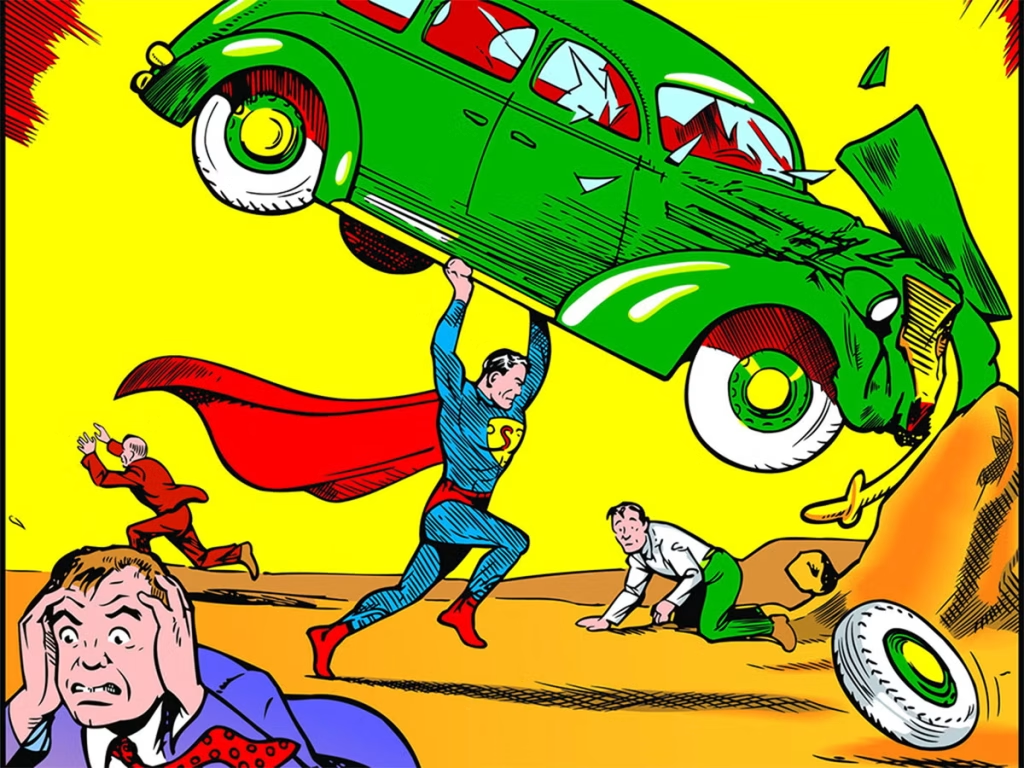
In 1938, two Jewish men from Cleveland debuted a character in a comic book titled Action Comics #1. Jerry Siegel was the writer and Joe Shuster was the artist. At the time, in Germany, the Nazi regime had bastardized the concept of the Übermensch from Friedrich Nietzsche to justify racial supremacy. The two comic creators subverted this idea and named their character Superman. It was an obvious attempt to redefine what might be considered “superior” in the minds of the world.
The creators imagined someone strong enough to stop evil the moment the hero sees it. Superman was built to defend the most vulnerable. He is a protector who sides with the underdog, fights tyranny, and stops corruption.
The Nazi party actually noticed this subversion. In 1940, the official SS newspaper, Das Schwarze Korps, published a vitriolic attack on Jerry Siegel, calling him an “intellectually and physically circumcised chap” and mocking Superman as a Jewish fantasy. The creators’ act of creation was so powerful it drew direct fire from the Third Reich before America even entered the war.
To even entertain the notion that Superman would kowtow to an authoritarian regime, or any government with strict dictates against freedom of thought and expression is farcical on its face.
Yet even today there are those on the political right who claim that Superman is meant to be a stoic character, god-like, who is not only physically but emotionally invulnerable. One who would never crack a smile, cry at the death of a loved one, or become angry at the United States government shooting protestors in the streets. The premiere issue of Action Comics debunks all of that.
In his first comic, Superman fights corrupt politicians, domestic abusers, and corporate fat-cats. In essence, Superman was a New Deal Democrat right from the start. He was seen as the hero who could put a halt to fascism, not one who might uphold it. He didn’t start with god-like powers either. Yes, he was stronger than the average man and invulnerable to bullets. But there were limits. He could not yet fly. He could take large leaps. He could lift cars above his head without trouble. Yet there was no indication his strength was limitless. Nor has there ever been the indication that Superman can’t be hurt, bleed, or even die in all of his long history.
While acting stoic and showing no empathy at the suffering of others from authoritarian aligned people might on the surface look “manly” and hero-like, it is not. That is just performance. One of the first and most crucial tools of tyranny is to dehumanize others. The only way to do that is to remove our empathy for one another. To remove our community and act as if we don’t feel the pain of those in need is the goal of all authoritarian regimes. Often that starts by encouraging hypermasculine attitudes as if showing emotions is a weakness rather than a universal human experience.
Superman is a true hero to and for the people. He’s an immigrant from a dead culture who sought refuge in America. Upon arrival he immediately began contributing to society and helping people. Rather than seeing humans as alien in his Kryptonian view of the world, he strives to become the most human amongst us.
Superman Continued to Fight Far Right Agendas Long After Action Comics #1
In comparison to other comic book characters of the World War II era, Superman was a little slow to join the fight in an overt manner. But when he did join the fray, it happened even before Captain America famously punched Hitler on the cover of his 1940 debut. Instead of a standard comic issue, the creators of Superman published an imaginary story in Look Magazine depicting how the hero could end the war. It might have been more bold to put the story into Action Comics but it was still a poke in the eye of the Nazi regime. But his fight against those with ridiculous ideas of racial superiority didn’t end there.
Just after the war, Superman was hugely popular and had his own radio show. In 1946, the Adventures of Superman radio show ran the “Clan of the Fiery Cross” storyline. Activist Stetson Kennedy had infiltrated the KKK, learned their secret code words, rituals, and hierarchy, and passed the information to the show’s producers. By exposing the Klan’s ridiculous secret handshakes and titles on a massive children’s broadcast, the show stripped away the mystique and terror of the group. It humiliated them, destroyed their recruitment numbers, and mobilized the community against them.
Gene Luen Yang, a Bay Area comic book creator best known for American Born Chinese, has a fantastic and fascinating graphic novel loosely based on the Clan of the Fiery Cross storyline titled Superman Smashes the Klan. Written in 2019 the book proves Superman is as against hatred now as he has ever been.
In Action Comics #900 (2011), Superman actually renounced his US citizenship because he was tired of his actions being used as political policy by the US government after he walked with peaceful protestors in Iran. While some on the right viewed this as being un-American, Superman was exercising one of our most fundamental freedoms as Americans. The right to peacefully assemble. A right the government in Iran is still suppressing even now. Superman, at this point, realizes that even American government can be led towards authoritarianism and he is a symbol more meaningful than any single government. As our own government shoots protestors, it is reassuring to know if Superman were real, he would be in the streets protesting with us.
Absolute Superman is a current title featuring an alternate universe in which Superman is directly confronting billionaires, using his empathy to try to understand the world today, and taking action. Again he displays radical empathy. He’s intensely affected by the pain and deaths of those around him. The most current iteration of the character is still doing what he did in his debut comic.
The act of reading these stories alone is a tool against fascism. These stories teach us that the most heroic of heroes is one that feels emotional depth, understands those in need, and then does something about it. No matter the cost to himself. Yes, he is physically invulnerable to most things. However, losing one life of any human is more devastating to Clark Kent/Superman than dying from kryptonite poisoning.
Some people have criticized the most recent film adaptation of the character as showing him being too kind. With Superman that is literally impossible. His whole character is radical empathy and meaningful kindness. And his hope is to spread this kindness to the world.
Superman Creates Community

If you look at the long history of the world’s most famous superhero you will see that he believes in hope for others so strongly he himself becomes a symbol of hope in the real world. The S shield that he wears on his chest is one of the most universally recognized symbols on the planet.
Young kids in Kansas in 1946 could wear that symbol on their chests believing there was hope to stomp out the KKK. People in Iran can wear the symbol believing Superman would stand with them in a fight for an equal society. Because he did. And we, as Americans, can march in the streets wearing his symbol, knowing it is one of hope that stands against government overreach.
Superman doesn’t just care about those he fights for either. He cares about those he fights against. He has the power to snuff out any human life in the blink of an eye. Yet this hero has a long-running arch nemesis whom he cares deeply about. Lex Luthor has come in many forms from mad scientist, to corrupt business mogul, to scheming politician. Yet he lives. Why? Because fundamentally, at his core, Superman has hope. He has hope that even the worst of us, those of us who have wronged others, and are self-dealing have the capacity to be better.
Fighting fascism means building community. This means there are going to be times when we have to realize people have the capacity to change. While we should hold people accountable for their actions, there are those caught in the grip of an authoritarian movement right now in America that will need us all to display Superman’s greatest strength. His radical empathy and sense of community.
A List of Standout Superman Stories for Fighting Fascism
If you want to dive deeper into the history, the anti-authoritarian roots, and the radical empathy of the Man of Steel, add these ten essential stories to your reading list. Most of these you can find on DC Universe Infinite if you have it. My preferred method is checking them out from your local library. I’ve added the links for convenience but they are not affiliate or sponsored links.
1. Action Comics #1–10 (1938)
- By: Jerry Siegel and Joe Shuster
- The Blueprint: The original Golden Age run where Superman acts as a New Deal populist, directly fighting corrupt politicians, slumlords, domestic abusers, and corporate profiteers who oppress everyday citizens.
- Read it here: DC Universe Infinite – Action Comics #1
2. Look Magazine – “How Superman Would End the War” (1940)
- By: Jerry Siegel and Joe Shuster
- The Blueprint: The historic, two-page feature story where the creators bypassed US neutrality laws to show Superman flying to Berlin, demolishing the Nazi war machine, and dragging Hitler to the League of Nations.
- Read it here: Internet Archive – Look Magazine
3. The Adventures of Superman Radio Show – “Clan of the Fiery Cross” (1946)
- The Blueprint: The groundbreaking 16-part radio serial that weaponized real-world Ku Klux Klan secrets, codes, and rituals to humiliate the hate group, tank their recruitment numbers, and build community resistance.
- Listen to it here: YouTube Playlist – Clan of the Fiery Cross
4. Superman Smashes the Klan (2020)
- By: Gene Luen Yang and Gurihiru
- The Blueprint: A brilliant modern graphic novel adaptation of the 1946 radio show. It explores bigotry, immigrant identity, and structural racism through the eyes of a Chinese-American family in Metropolis and a young Clark Kent coming to terms with his own alien heritage.
- Read it here: DC Universe Infinite – Superman Smashes the Klan
5. Action Comics #775 – “What’s So Funny About Truth, Justice & the American Way?” (2001)
- By: Joe Kelly, Doug Mahnke, and Lee Bermejo
- The Blueprint: Superman faces off against a cynical, violent team of anti-heroes called The Elite. It stands as the ultimate rebuttal to anyone who claims Superman should be a cold, executioner-style god, proving that his restraint is a deliberate choice to reject authoritarian power.
- Read it here: DC Universe Infinite – Action Comics #775
6. All-Star Superman #10 – “Never-Ending” (2008)
- By: Grant Morrison and Frank Quitely
- The Blueprint: A masterpiece of emotional scale. Facing his own mortality, Superman spends his time protecting the micro-details of the planet, culminating in a legendary, life-saving act of pure empathy for a lonely teenager.
- Read it here: DC Universe Infinite – All-Star Superman #10
7. Action Comics #900 – “The Incident” (2011)
- By: David S. Goyer and Miguel Sepulveda
- The Blueprint: The controversial and powerful short story where Superman renounces his U.S. citizenship to prevent the federal government from using his personal, anti-authoritarian actions—like walking with peaceful democratic protestors in Iran—as state policy.
- Read it here: DC Universe Infinite – Action Comics #900
8. Superman: Peace on Earth (1998)
- By: Paul Dini and Alex Ross
- The Blueprint: A stunning graphic novel exploring the limits of power. Superman attempts to spend a day feeding the starving populations of the world, only to discover how dictatorial and militarized regimes weaponize human deprivation to stay in control.
- Read it here: Goodreads – Superman Peace on Earth
9. Absolute Superman (2024–Ongoing)
- By: Jason Aaron and Rafa Sandoval
- The Blueprint: The most current, modern run reimagines Kal-El without his usual safety nets. Left to navigate a cruel world alone as a blue-collar immigrant, he uses his radical empathy to directly confront exploitative corporations, corrupt systems, and billionaires.
- Read it here: DC Comics – Absolute Superman Hub
10. Superman Red & Blue (2021)
- By: Various Creators
- The Blueprint: An anthology series stripping the character down to his core traits. It focuses entirely on everyday kindness, showing how a person with unlimited physical strength uses small acts of solidarity to mend broken communities and instill hope.
- Read it here: DC Universe Infinite – Superman Red & Blue (2021)
Next Time
My next post in this series will be on Maus by Art Spiegelman.

