Comic Books for Fighting Fascism – Captain America

Captain America #1 by Joe Simon & Jack Kirby

This series of posts was inspired by the Popsmart Instagram series Films for Fighting Fascism by Professor Shannon Mancus. She’s much smarter than I am and has more degrees than I do but I bet I’ve read more comics than her.

(Note: this post contains affiliate links. If you purchase something through this post I will get a small commission at no extra cost to you)

American Hate Rallies

Madison Square Garden holds 20,000 people. It’s been a venue for musicians, artists, comedians, sporting events, and has been home to at least two American hate rallies. These rallies centered around a buffoonish leader who worshiped a foreign authoritarian and wanted to spread a message of violence, othering, and fear to the American people.

In 1939, a man named Fritz Julius Kuhn, head of the German American Bund, spoke on stage with a huge portrait of George Washington behind him. Framing the portrait were two American flags and two banners with large swastikas emblazoned on them.

At the time, the mayor of New York, Fiorello LaGuardia had been warned that this rally could be dangerous. This was before America entered the war and the government had thus far assumed an isolationist position. The goal of the Bund was to sway sentiment to bring America to war on the side of the Nazis. LaGuardia allowed the rally to proceed, noting free speech rights. He did believe the rally would be the downfall of the hate group, later stating, “I believe in exposing the cooties to the sunlight, and we recently had an exhibition of international cooties.”

While the mayor had a point in letting the buffoonery play out, there was one man who directly stood up to Kuhn in the moment. Isadore Greenbaum had seen the advertising for the rally and wanted to see what all the fuss was about. He was well aware a hateful little man was going to be speaking in front of a large crowd. What Greenbaum did not expect was what he observed in the crowd. As the rally went on, he saw the speakers become more hateful, more antisemitic by the minute, and he saw several of his neighbors, friends and colleagues cheering for the speaker. Greenbaum did not plan any sort of protest but observing what he knew to be wrong, he rushed the stage and unplugged the microphones. He was promptly beaten by members of the Bund for it. This was exactly the kind of violence Kuhn wanted to stir.

The rally received international attention. There was an atmosphere of fear and anger brewing on both sides of the rally. While there were definitely more people strongly opposed to Nazism, there were pockets of America where the ideology was gaining ground. America’s position on what to do about the war taking place in Europe was not truly cemented until after the Pearl Harbor attack in December, 1941. The debacle of the Bund rally may have changed some minds. But mostly in favor of fighting rather than joining the Nazis.

Far ahead of the curve in standing against Adolph Hitler and his Nazi goons were Joe Simon and Jack Kirby. The cover of the first issue of Captain America featured a man wrapped in an American flag punching Adolph Hitler directly in the face. To add insult to Hitler’s injury, Captain America was not only unabashedly anti-Nazi, he was a blond-haired Adonis-like figure, one of the ideal pictures of humanity and masculinity that Hitler believed was superior. Much like Greenbaum, Simon and Kirby saw what was happening and decided to do something about it.

In 2024, Madison Square Garden was home to another buffoonish leader who wanted to stir up the crowd with violent and racist language, hoping to make a direct connection between the 1939 Nazi rally and current feelings of hatred towards several out groups. This is not just my opinion. Leading scholar, researcher and historian who specializes in understanding the authoritarian play book Ruth Ben-Giat also believes there is a direct comparison between the two events.

The Bund rally was exposed for what it was by a single man taking action. Yet the MAGA rally attempted to work on two levels. First and foremost, it was a dog whistle to anyone who truly believed in the racist component of the America First, isolationist, anti-immigrant policies Trump would go on to enact. Secondly, it operated as a mechanism of attempting to discredit anyone trying to condemn this rally as being anything like the 1939 rally. It was not technically held in the same structure, as Madison Square Garden had been rebuilt in the intervening years. This rally didn’t require any kind of formal membership in an organization for someone to be a speaker. There were not uniforms for everyone onstage. However, most of the audience members were wearing the same red hats.

If someone on the left mentioned this was a hate rally, the MAGA movement attacked back by stating they were “trolling the libs” or saying they were offended to be compared to the hateful groups of the past. Yet the language used there reflected much of what the American Bund was saying in 1939. One speaker at one of the rallies said, “America is for Americans and Americans only.” A speaker at the other said, “…restore America to the true Americans.” Without looking it up can you tell which one came from which rally? They are both anti-immigrant, American isolationist statements. And Ruth Ben-Giat’s comments on Trump trying to normalize violence and violent rhetoric have become disturbingly prophetic. One only needs to view how certain television networks defend any kind of violence against immigrants, protestors, or anyone else MAGA hates to understand how this has taken hold.

To bring this back to Captain America, he was in part inspired by the rally in 1939 as well as other pro Nazi news and sentiments that continued in the following years. And today, in 2026, this character would still punch a fascist in the face. That has never changed. If it was as simple as standing up to bullies, Cap could already teach us a lot. But, Captain America has never been the perfect vehicle for delivering anti-authoritarian messages. In fact, we can learn much from the creator’s mistakes as well as from the successful actions of Steve Rogers and other characters who have taken on the mantle of Captain America. 

The Early Days of Captain America

If you look at the earliest issues of the comic book you will find lots of war stories, plenty of action, a superhero ready to defend his country along with his young counterpart Bucky Barnes, and far too many racist depictions of anyone who was not white. Especially bad depictions are made of Asian and Black characters in the book. While fighting the Nazis was and remains a laudable goal, the book is filled with jingoism from cover to cover in the early days. The book never really addressed things like Japanese-American internment camps in the country, nor did it provide any nuance to the evil bad guys. Which, in part is fair. Nazis were and are evil. It’s probably not up to a comic book like Captain America to convince us how normal people can be swept up in the atrocities that came out of World War II.

It’s also important to note that the creators of the book didn’t only make comics. They themselves served in the war. Jack Kirby even had a hand in helping to free people imprisoned in a concentration camp. Because of his artistic skills he was often sent out to scout ahead and draw maps of locations. He was a valuable asset to the war effort and he was fighting fascism before it was cool and he still helps us to do so now. The character he created has had an immeasurable impact on the fight against authoritarianism. Unfortunately, because he is draped in the American flag, sometimes those same authoritarians try to claim this character as being on their side. He is not, has not ever been, nor ever will be on the side of fascist ideals.

Early mistakes aside, Captain America has always fought not for what America is, but what it could be. Steve Rogers was experimented on and became the first super soldier. Immediately after, the man who developed the serum was killed by German spies. This makes Steve Rogers a uniquely American hero in the Marvel universe. But he does not become an instrument of the government. In the earliest issues he fought the good fight during the war. He was part of the military so he did work for the government in that way. But that never meant he had to fully comply and agree with everything our government did.

Captain America Reborn

There are two basic phases when it comes to Captain America the comic book. First, the war phase. G.I.’s in the actual war would receive care packages and they were often filled with comic books. Captain America for obvious reasons was one of the most popular titles. This continued through and a little after the war. But by 1949 the book felt less relevant and Cap had his first hiatus. He disappeared from newsstands until 1953 when he was brought back to fight the “commies” for a while but it was short-lived and the title went away again in 1954.

The main phase of Captain America, the one we all know and recognize now actually debuted in Avengers #4 in 1964. Stan Lee brought him back by explaining that Steve Rogers had been frozen in ice for 20 long years. Because of his super soldier serum he was able to survive and went on to be one of the most important, recognizable, and powerful superheroes of the Marvel age. In the MCU this gets extended to match our current timeline showing him as frozen for 66 years in the films. I suspect this will continually get recontextualized because the character simply works best if he is a man out of time who is trying to understand our current era.

From this rebirth of the character is where things get interesting with Steve Rogers. He always sticks up for others, he’s a good leader because he empathizes with everyone, and he’s willing to make his voice heard whether the government thinks it is a good idea or not. In the 1970’s during the height of the Watergate scandal the book heavily implies but just doesn’t quite show all the way that Steve opposed corruption in the White House. Just like he would now. This story was Captain America #169–175 (“The Secret Empire”). And it remains one of the greatest Cap stories of all time.

In fact, Steve Rogers sticks to his principles so much that he is willing to walk away from his own title in the story The Captain (#332–350). Written by Mark Gruenwald, this story shows what happens when he refuses to become a weapon for state authoritarianism. Steve gives up his uniform and shield, operating instead as an independent hero named “The Captain” while a violent, state-sanctioned replacement takes his place. You can see where the conflict comes from with that one.

In 2005, Ed Brubaker had a legendary run on Captain America where he brought back Bucky Barnes as The Winter Soldier. In that story, a corporate-fascist executive named Aleksander Lukin weaponizes elements of the U.S. military-industrial complex and S.H.I.E.L.D. from within. It highlights how easily bureaucratic institutions can be subverted by totalitarian interests. Which is exactly what we see now when we see that the Trumps invest in drone companies and then those drones are literally used to kill people in wars we had no business starting. It’s all done for control and profit.

Another notable instance of Steve Rogers fighting against the status quo was the events of Civil War. This story doesn’t tie directly into fascism in America, but it does show that Steve will stand on principle over orders. For this story, I strongly recommend reading the comics over watching the movie because the film loses most of the nuance that gave meaning behind Cap’s actions.

While I could continue listing stories that involve Steve Rogers and are great starting points for fighting fascism, there are two recent stories that highlight the worst and best ways to fight fascism. The Secret Empire remake was a backfire of epic proportions while Truth: Red, White, & Black is a masterclass in recontextualizing and adding to the rich history of comics that shows us knowing history is vital for fighting against authoritarianism.

The Secret Empire Remake Debacle

One of the fascist institutions in Captain America comics right from the first issue was Hydra. This is an evil organization run by Nazis and headed by the evil Red Skull. Think of him as the Joker to Steve Rogers’ Batman. In the 1970s the creators of Captain America had the foresight and integrity to call out what the American government was doing and force Steve to confront the implications of a corrupt White House. This is one of the reasons it is considered amongst the best Captain America stories ever told. It’s no wonder there was an attempt to remake this in 2017. But the creators of the modern series made huge mistakes.

Remakes, rewrites, and re-imaginings are frequent in comic books. Sometimes they provide new context, sometimes they revitalize a forgotten character, and sometimes they are better stories than the originals. 2017’s Secret Empire was none of that. This is where we get the Nazi Steve Rogers. It was supposedly not an alternate reality, not a dream, not anything that could easily be waved away by a writer. In the story the creators reveal that Steve was, and had always been, part of Hydra. Pushing the envelope in comic books is good. But shocking for shock value when it comes to fascism? Well, that was a mistake. Readers did not take kindly to this version of Captain America and for good reason. We could all see what was happening with the Trump administration. Even in the first term they were restricting travel, caging families, and becoming more isolationist than is healthy for any country. To have a symbol like Steve Rogers suddenly side with people like that? It tore at the hearts of comic book readers in a way that felt unforgivable.

As I am sure you can guess, if you read comics, there was a long and complicated route that brought back our beloved Steve Rogers. We still, now, have the man who will fight Nazis, not be one.

This story was also counter to the depiction of Steve we see in the films. He does watch Hydra surround him in some of those movies. The organization penetrates S.H.I.E.L.D. from within but Steve himself? He is on an elevator and watches several of these agents get on with him. He knows what is coming and he just lets them keep loading up the elevator. He not only fights his way past them while inside of a crowded elevator, he beats the hell out of them so they will never forget who stood up to them. He goes on the run from the government until he can clear his name. He fights Iron Man, one of his closest allies, just to stand up for what he believes in. And in Chris Evans’ depiction of the character is where we get one of the most memorable lines Captain America ever says. He gets knocked down over and over both physically and metaphorically. But what does he do? He stands back up and says, “I can do this all day.”

It was a strange whiplash to have that character on film while in the comics he was saying, “Hail Hydra.” As far as the mechanics of the story, it was a solid foundation but the timing and the execution were simply terrible. And it made readers who love the character walk away from him.

If you left the books because of that, I can tell you it is safe to return because we do have the real Steve back now. But if you can’t forgive it for taking an icon of independence and even temporarily turning him into a fascist, well, I can’t blame you either.

One thing to note about Captain America whether we are talking about the comic books, the movies, or almost any other iteration, is that these stories are told from the white, straight, American male perspective. Steve surrounds himself with people from all backgrounds and to those of us, like myself, who share Steve’s ideals and skin tone, we should remember that he has a whole team around him who help him to succeed. He cares about all of them but sometimes, he must be the one to speak because those with less representation are often not heard. It’s why having this white, blonde, American man punching Hitler in the face was so effective all those years ago. We might look like some of these fascists but that sure as hell does not mean we agree with them.

But there is one incredibly impactful story that was told from a different perspective and is simply incredible in the delivery is Truth: Red, White, & Black.

Truth: Red, White, & Black

You’d think after decades of comic books about Steve Rogers there wasn’t anything new to learn. But in 2003, we got one of the most impressive Captain America stories ever and it had almost nothing to do with Steve. Written by Robert Morales and illustrated by Kyle Baker Truth: Red, White, & Black tells the story of a group of black soldiers who receive early versions of the super soldier serum that worked on Steve Rogers.

The difference? These men didn’t volunteer to become a superhero. No, they were experimented on and used by their own government even as they were trying to fight for freedoms they never fully enjoyed at home. It mirrors the real life events of the Tuskegee Syphilis study where 399 Black sharecroppers who had Syphilis were told they were being treated for their “bad blood.” This was done simply because the government wanted to see what would happen if they let the disease play out without real treatment. The government could have cured these men but chose not to. It remains one of the most shameful incidents of American history and if you don’t know about it, look it up before this administration erases all the records of it.

As far as the comic goes, this group of black soldiers is injected with the serum. Several of them die immediately. The white officers show no compassion for these soldiers and the experiments continue. Eventually, a few do survive the process. They end up with super strength but they also look like mutated abominations as a result. Soon, most of them die as well as the long term impacts of the serum are not yet understood.

Finally, one soldier seems to take well to the serum. His name is Isaiah Bradley. And if you go by his timeline, he’s technically the first Captain America despite the fact that Steve Rogers is making appearances in his uniform in the U.S. at this time. And Bradley is assigned a mission from hell. He is tasked with liberating a Nazi death camp. He’s supposed to go with Steve Rogers who is unable to show up through no fault of his own. Bradley decides to take the uniform meant for Steve and free the people in the camp. He is successful although he can’t save those who died already and those who are too near to death to make it for long.

And there’s a heartbreaking scene where a fair number of people die as Bradley, try as he might can’t save them and he himself is captured by Germans.

One would think that a war hero of that caliber would return home to a grand welcome with a parade and a celebration. Instead? Bradley is court-martialed and imprisoned for 17 years for stealing the uniform. Steve Rogers has no knowledge of any of this. And because of the effects of the serum, Bradley is mentally compromised and in a very sorry state when Steve does finally find out about the “Black Captain America.”

The story is moving and does not shy away from the atrocities of war, of American government, from institutional racism, and it still allows us to know that fighting fascism is worth the effort. It doesn’t try to hide or change history the way this administration wants to. It shows the flaws of America and the strengths. It’s a story that without ever saying it explicitly allows the characters to get knocked down over and over just to get back up and say, “I can do this all day.”

This is why we need to fight to preserve all of our history, not just some of it. When we find out new information that we didn’t fully understand, we can acknowledge there are good fights to be had that sometimes we execute poorly. The main thing we have to do is not lose hope. We all need to be able to do what both Isaiah Bradley and Steve Rogers did. We might take some punches. We might get knocked down. Sometimes, we even pick the wrong fight. But as long as we are fighting against fascism? We’ll get back up again and punch a Nazi in the face.

How We Can Learn From Captain America

It’s not always easy to know what to do when you are confronted with true evil. I grew up thinking people with fascist ideas were far off somewhere in the past, already dealt with. But now, when I see things like the rally at Madison Square Garden, when I hear people like Stephen Miller, as I watch ICE capture, beat, and kill citizens and non-citizens alike, I know that was a false version of reality. Fascism is here and now in America.

It’s trying to gain strength. It’s trying to amass crowds and overrule those of us who think, look, or are different. Fascism is in our headlines every single morning now. And the media companies keep falling prey to the idea of capitulating to authoritarians. They should remember how well that worked out for those who surrounded Hitler. It was not a kind end for any of them.

There are some things we need to remember. First, the idea of reading, making, and sharing something like a comic book with an anti-fascist message scares the hell out of these people. And for good reason. Comic book fans are a community. We talk to one another. We share common interests and most of us understand the subtext of what we read. This makes us more educated than the Trump administration would like us to be. When you read a Captain America story, especially one of the great ones, you are committing a small act of defiance against this regime.

Second, let’s remember not to give up hope. Steve Rogers doesn’t. Isaiah Bradley had every reason to but he doesn’t either. Even when Steve leaves his uniform behind, he’s still fighting for what this country could be. He sees those Hydra agents and welcomes them to the elevator and gives them a chance to change their minds before he beats them down.

But the biggest lesson we get from Captain America isn’t even the line from the movie, “I can do this all day.” It’s what you watch him do when he says it. Captain America stands up. Every time. He stands up when they knock him down. He stands up for others. He stands up for freedom. He stands up to fascists. And yes, he punches them in the face and does not apologize for that.

Remember to always stand up for what is right, even when it feels hopeless, even when you are running out of steam. They are afraid of anyone willing to get off of their knees.

Recommended Reading for Captain America

Marvel Unlimited has all of the Captain America comics you can read except for the most recent three months. Below are my recommendations for the greatest Cap stories of all time for fighting fascism.

Captain America Comics #1 (1941) – Steve Rogers punches Hitler in the face on the cover and this starts the whole thing.

Captain America #193–200: The Madbomb – Jack Kirby returns to the title and tells a story about a secret society of wealthy elites who plot to overthrow the U.S. government on the Bicentennial. They use a device called the “Madbomb” to strip citizens of their free will and reduce them to a state of mindless, violent rage. It remains one of the ultimate allegories for how fascist structures exploit chaos to seize power.

Captain America #247–255: Dawn’s Early Light – This run features Steve Rogers facing off against Baron Blood and his arch-nemesis, Baron von Strucker. It shows Captain America’s definitive ideological rejection of fascism, emphasizing that true patriotism means defending the freedom of all people, not blind obedience to a state or dictator.

Captain America: Sam Wilson (2015) #1–6 – Sam Wilson (aka the Falcon acting as the new Captain America) takes up the shield, facing a resurgence of the Sons of the Serpent, a fascist, white-nationalist militia operating along the US-Mexico border. Written by Nick Spencer, this run explores how modern fascism wraps itself in corporate messaging and internet culture, testing what the shield stands for in a deeply divided, modern landscape.

Captain America #1–14 (1998): Heroes Return – Written by Mark Waid, this run features a storyline titled “Man Without a Country.” The Red Skull uses a reality-warping Cosmic Cube to trick the world into thinking Captain America has turned fascist, resulting in Steve being exiled from the United States. It is a brilliant examination of how easily nationalistic fervor can be weaponized and manipulated by fascist propaganda.

The Secret Empire (#172–175) – Written by Steve Englehart, Cap discovers a fascist shadow group has infiltrated the highest levels of the White House. The storyline ends with the villainous mastermind committing suicide in the Oval Office. The shock causes Steve Rogers to temporarily abandon the Captain America identity entirely.

The Captain (#332–350) – Written by Mark Gruenwald, a corrupt government committee demands Cap report directly to them and follow political orders. Refusing to become a weapon for state authoritarianism, Steve surrenders his uniform and shield, operating instead as an independent hero named “The Captain.”

Winter Soldier / The Red Menace (#1–14, 2005) – Ed Brubaker’s legendary run shows a corporate-fascist executive named Aleksander Lukin weaponizing corrupt elements of the U.S. military-industrial complex and S.H.I.E.L.D. from within. It highlights how easily bureaucratic institutions can be subverted by totalitarian interests.

Civil War (2006) – The U.S. government passes the Superhuman Registration Act, turning the country into a surveillance state that strips citizens of due process. Cap refuses to enforce the law, leading a underground rebellion against his own government and former allies.

Truth: Red, White & Black – Written by Robert Morales and illustrated by Kyle Baker, this groundbreaking historical fiction series unearths the tragic secret history of the Super-Soldier program. It serves as a direct comic book allegory to the real-life Tuskegee Syphilis Study.

Next up on Comics for Fighting Fascism: Persepolis

Comic Books for Fighting Fascism – Maus

Cover of Maus I by Art Spiegelman

This series of posts was inspired by the Popsmart Instagram series Films for Fighting Fascism by Professor Shannon Mancus. She’s much smarter than I am and has more degrees than I do but I bet I’ve read more comics than her.

Maus is a Masterclass in Narrative Storytelling

Maus by Art Spiegelman is a personal narrative about Art’s father Vladek who survived the Holocaust. It’s also a deep personal reflection about Art’s relationship with his father. It’s a story that does not flinch; it does not compromise, and although it is obviously fictionalized, it tells the truth in a way most historical accounts can’t. And it gives us a powerful tool for fighting fascism. At the end of this article, I’ll give you five words capable of kneecapping some of the worst tendencies in authoritarian regimes.

But first, let’s talk about the most obvious differentiator of this narrative from any others. Art Spiegelman’s brilliant stylistic choices. In the story Jewish people are depicted as mice, Nazis and other Germans are depicted as cats. There are a few other animal metaphors and choices in the art but the cat and mouse dynamic is the most significant. On the surface this seems simple. Nazis are predators and Jewish people are the prey. But this is also a personal connection to Vladek, the main character. For several years he plays a cat-and-mouse game of life and death with the Germans. Vladek is sometimes able to hide or blend in because, despite the nonsense of what Nazis think, it is not obvious on the surface if someone is Jewish or not. And he has certain resources and connections that help him to survive. Yet, even though we know his survival occurred, the story shows how random it was as far as who did and did not live to tell their own stories. His survival is one of allocating resources, relying on his strength, understanding when to bargain with someone, and sheer luck. There is not one thing in particular we can point to that lets us understand why Vladek survived while so many others did not. Early in the narrative it is easy to say he survived because he had more wealth and resources than others. But as everyone is stripped of their power, first slowly, then shockingly rapidly, access to those original resources matter less and less.

As the story unfolds, and things become worse in Poland and other places Vladek is in, we see occasions where there are Germans who are not Jewish caught up, executed and mixed in with the mice. There is even a point where Art changes the drawing of one person from a mouse to a cat in the camps. Vladek is not sure but he believes this could have been a German who was not Jewish. This again goes to show how ridiculous the Nazi ideas of racial superiority were. And the narrative doesn’t back down from showing terrible things people forced into the ghettos and camps did to one another. Nor does it back down when the narrative shifts to the present and we see certain prejudices that Vladek himself has.

The creator of this comic book did not have to choose to draw everyone as animals. And in fact, there are times when he shows people wearing an animal mask rather than being simply a mouse, cat, pig or any other animal. No medium other than comics could have pulled this off so well. Yet the drawings are largely simple. When the art does make a visual statement, when it goes into graphic detail, those panels pack an undeniable punch. It does not matter that we are looking at cats, mice, pigs, and dogs. We know these are humans. Add to that the fact that the first tool of fascists is to dehumanize any group they don’t align with until no one is human and the structural significance of the metaphor clicks into place. It’s an absolutely brilliant artistic choice that no one but an independent comic book creator would dare to make.

It helped that Spiegelman was already an independent undergound comic book creator before he started making this. It helped him to think outside of the box that we find in dry historical records. For whatever reason, this choice works so perfectly and the story is told so well that Maus won the Pulitzer Prize. It’s even become an educational tool teachers often use to convey the real horrors of what humans are capable of.

Visual choices are not the only thing that make this work a masterclass. If you read Maus, there is one word that describes it better than any other. Honest. The title of part one, My Father Bleeds History is about as honest as you can get. Vladek tells his story in vivid detail and the story jumps to life on every page. We do see Vladek bleed in the flashbacks to what was happening leading up to and during the Nazi takeover of Germany and Poland and we see him pour out his history to his son. We can even see some of the psychological trauma that likely lingered in Vladek because of his experiences.

At the same time, Art has a complicated relationship with his father. We see this from the narrator’s perspective and even see panels where Art struggles with his own decisions about this project. It adds a layer of honesty to what was already a gripping story. Through Art’s eyes we can wonder if some of the traits Vladek has are because of his trauma or just because of who he is. There is no obvious answer to this question, nor should there be. People, even people who have experienced the worst of humanity, are complicated. There is one point in the narrative where Art reflects on his older brother who died years before he was born. He implies he has a sibling rivalry with a photograph. This is such a complicated dynamic through no fault of Vladek’s or Art’s yet it is a significant reminder of the lives that have been lost. Trauma is passed on generationally in these situations, leaving victims not only in the past but also in the present. This is why narratives like this are so incredibly important to share.

Another way to tell this story has significant meaning is by how often it has been banned. Fascists hate true things. They also hate historical context. And they hate art.

Some people might argue that fascists have their own forms of art. There were Nazi films, books, literature, etc. This was propaganda and while it has the veneer of art, it is not true art. Much in the same way we can look at an AI generated image and understand it is not true art, if you look at the posters, flyers, films and other types of media forced on the public by the Nazis, it is clearly hollow and has no true artistic vision behind it.

Maus is honest art. And that terrifies fascists. For that reason alone, you should read it.

Fascists Are Trying to Suppress Art and History Right Now

Whether you want to call the Trump administration fascists, authoritarians, oligarchs, kleptocrats or something else is irrelevant. They are enacting authoritarian policies that align far too well with the Nazi regime right now. They have spent years dehumanizing immigrants, black people, gay people, trans people, and anyone else who doesn’t fit their ideal of perfection. Just like in Nazi Germany, this government now is telling the populace there is someone to blame for your troubles. It’s not your fault, it’s not the system’s fault that you are struggling, look over at this out group who we can all blame. Why do they do this? So that when they start censoring history, when they build concentration camps, when they kill humans, you will not think of that group as people. No. To you they are mice, rats, or whatever label they want to give them other than a person. This is the goal of fascists. And there is concrete evidence they are doing this now as you are reading this article.

There are already examples of exhibits in the Smithsonian being removed by the Trump administration. They want you to believe that anything they deem “woke” is bad. This is such a catch-all term that it has resulted in the removal of references to the aircraft the Enola Gay from Pentagon documents. This aircraft is one of two that dropped atomic bombs on Japan. It may be one of the most insane removals of history ever recorded. Yet the fascist regime claims they are only targeting “woke, DEI” policies. What does this have in common with Maus? The Nazis also used overly broad terms like “jew businesses and ideas” to justify committing violence against anyone they wanted to target. They are intentionally non-specific about what it means to be “woke” or “DEI.” And as people in Nazi occupied territories eventually came to realize, if you end up dehumanizing out groups long enough, you end up in one of the out groups that gets targeted.

No one wanted to believe the things they were hearing in Poland in 1939. Some people thought it would be best to work with the Germans to help round up Jewish people. Many of those people who did the rounding up also found themselves in the camps by the end. Often in the narrative of Maus Art asks Vladek what happened to certain people who helped the Nazis. Not every time but several times, Vladek says they also died in the camps. Some of the people who helped Jewish people were also killed. And there were others who did bad things yet survived. There were Holocaust deniers during the Holocaust because they didn’t want to believe humans could be so cruel. There are Holocaust deniers now because they don’t want you to know the truth behind history. They are terrified you will learn from it.

What the fascists of today want you to believe is that the Holocaust was not the way Spiegelman depicted it. To them, this is over, settled history, and we should move on. That’s because they want you to forget that Hitler at the start was seen as an over-the-top weird politician with odd ideas who they could ignore. They want you to forget that he then gathered a collection of other weird people with weird ideas and using a system that was broken, they set themselves up for power. This is exactly how we ended up with the current administration in America.. No matter what you think of people like Elon Musk, Donald Trump, and R.F.K. Jr., I doubt you would describe them as “normal.” And before you accuse me of overstating the facts, or exaggerating the horrors of this administration, let me remind you, we have concentration camps in America right now.

I’m not claiming this as an expert on concentration camps. Heather Cox Richardson, a noted American historian, has explained that these are, in fact, concentration camps. She has a fascinating historical record on her Substack titled Letters From an American and she consistently puts things into perspective on her YouTube channel. She has consistently explained not only the horrors of what is happening now but reminded us that a concentration camp is a place where you concentrate a large number of people. The immigration detention centers in this country qualify for the term. If that was not bad enough, the people in those concentration camps are being mistreated, undernourished, beaten, sexually assaulted, and sometimes outright killed. The administration wants you to think of those people in those facilities as non-humans. That way you will not be upset when a sitting U.S. Senator is pepper sprayed in his face as he goes to support the people protesting there. These are the same fascist tactics the Nazis used. And you can understand the parallels if you read historical narratives like Maus.

This is why Maus itself has been banned so often. And the reasoning given for trying to suppress such a narrative is beyond ridiculous. The book has been banned for having ‘explicit’ language. It has the words goddamn and bitch in it. For those on the right who are always going on about how much they hate censorship, it makes no sense to ban Maus based on the language. Our own president has used much more explicit words while giving public speeches. Another ground on which this is challenged is for nudity. There is one picture of Art Spiegelman’s mother in a bathtub after she committed suicide in which if you look very, very closely, you can see her breasts. In my opinion, only someone weirdly obsessed with genitalia is even trying to look at that. The final ground on which this book has been challenged is somewhat more valid but it requires nuance and context. This is deep subject matter and the themes in the book are obviously very dark. I think there is a discussion to be had about at what age it is appropriate to allow children to read this narrative. But as always when it comes to this question, there is one simple answer. It depends on the child. Some kids in middle school can handle these types of stories while others cannot. But certainly by high school children can understand this narrative. And it can help them to understand their own world. Fascists can’t stand educated children.

While I think it’s wholly unjustified to ban Maus, I don’t want you to worry about Art Spiegelman. He’s an extremely successful creator and banning his book tends to lead to more sales for him. What does concern me is other artists who are being banned that we are less aware of. I’m not going to tell you to go out and buy Maus right now (although I will provide a link if you want to). What I do think you should do is go check at your local library, your school library, or your local book store and find out if it has been banned there. If so, start a petition to request it be returned to the shelves. If we can prove that we can bring back books that have been banned, those lesser-known creators will have more room to express their narratives.

Now, let’s talk about the five words I have for you to use to fight fascism.

Write It Down. Create Art.

Vladek Spiegelman did not want to tell his story. Thankfully, Art Spiegelman did. He did it masterfully too. Vladek’s wife Anja wrote a series of diaries about her life. Unfortunately, Vladek, at some point, threw them out after her death. In the panels of Maus you can see how troubling this is to Art. It was an entirely different perspective on these events that he could not access. While Vladek’s story is essential historical reading, who knows how powerful those diaries could have become in the hands of someone like Art? We’ll never know.

I don’t think Vladek would have described himself as special, nor would he have described his wife Anja as special, except that they loved one another. Yet this narrative about a normal person living through the most horrific events imaginable imprints an indelible record on the collective conscious.

Right now there are children who have been housed in concentration camps in America. Some of them are going to grow up with stories to tell. They are going to explain to their children what happened to them. Right now there are people who are protesting these injustices in the streets. Already we know some of them will not be able to tell their own stories as their lives were cut short. Right now there are people being fed meals filled with worms in detention centers in America. These are not things that have happened in the past, these are things happening at this moment. We have YouTube, TikTok, cell phone videos, news reports, and articles explaining what is happening. We have political pundits trying to spin these events as normal. We have other pundits pointing out the true horrors. These are important things to have. But we also need people to write it down. We need people to make art. We need you to tell your story. We need you to make your art. I don’t care if you’re just an average, everyday, normal person. Ruth Ben-Giat, another noted historian, in her book Strongmen, mentions that simple, everyday acts of defiance can contribute to the toppling of an authoritarian regime. This can include personal stories. And it includes art.

If you know someone who has been taken by ICE or who has been fired by the administration because of their “anti-woke” policies, write it down. Make art out of it. Even if you don’t it can help to just record how you are feeling about things today. Eventually someone may read it and it might make a huge impact on the collective conscious like Maus did.

I’ll admit I have tried to keep a personal journal for years. I almost always end up abandoning it. Your art does not have to be a personal narrative. We still need your art. Not AI generated art, but personal, human art that can reach us. Even if it’s simply a romantic fantasy, we still need it. We need musicians, artists, and every type of creator to continue to make art. And if you’ve never tried it, now is the time.

For me, this series of blog posts is my version of writing it down. While I am no artist and I am not good at creating visual art, I do know comics. I read them all the time and I have done so since I can remember. I can see what is happening today and see how it relates to what I have read in said comics. I don’t know if anything I write will ever make an impact to anyone. But I feel the need to share it either way. And I want you to do the same. Whatever that looks like to you, I want to see it. And someone else is going to want to see it as well.

If you have an anti-authoritarian streak in you, write it down. Make art. The fascists hate it when you do. And to me that is more than enough reason to do it.

Where to Find Maus

Please check your local library or book store to see if they have a copy. It’s not easy to find digital copies but the book is in print everywhere. The best version to read is called The Complete Maus and it contains Maus I and Maus II which were printed as separate books.

In case you can’t find it, I do have a link to it from the Internet Archives here. But, like I said, please check your closest library first.

Next Time

My next post in this series will be on Captain America.

Captain America #1 by Timely Comics

Comic Books for Fighting Fascism – Superman

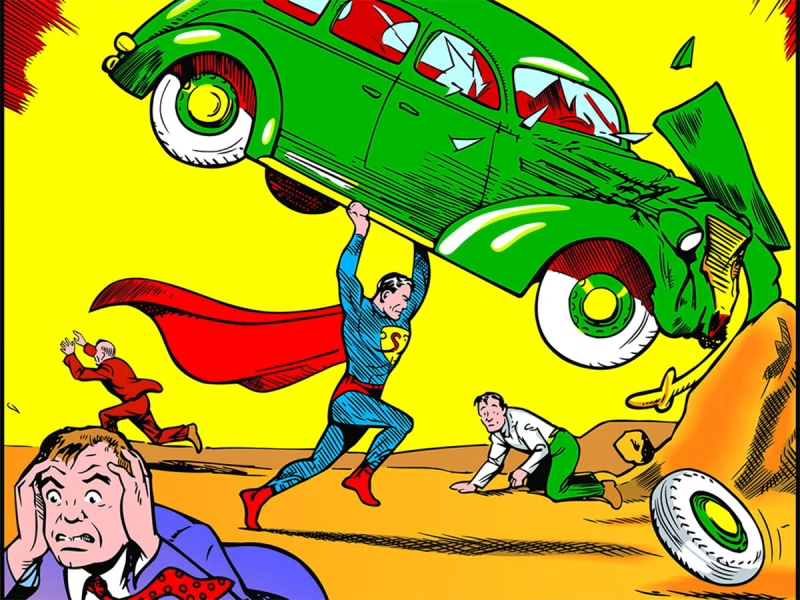
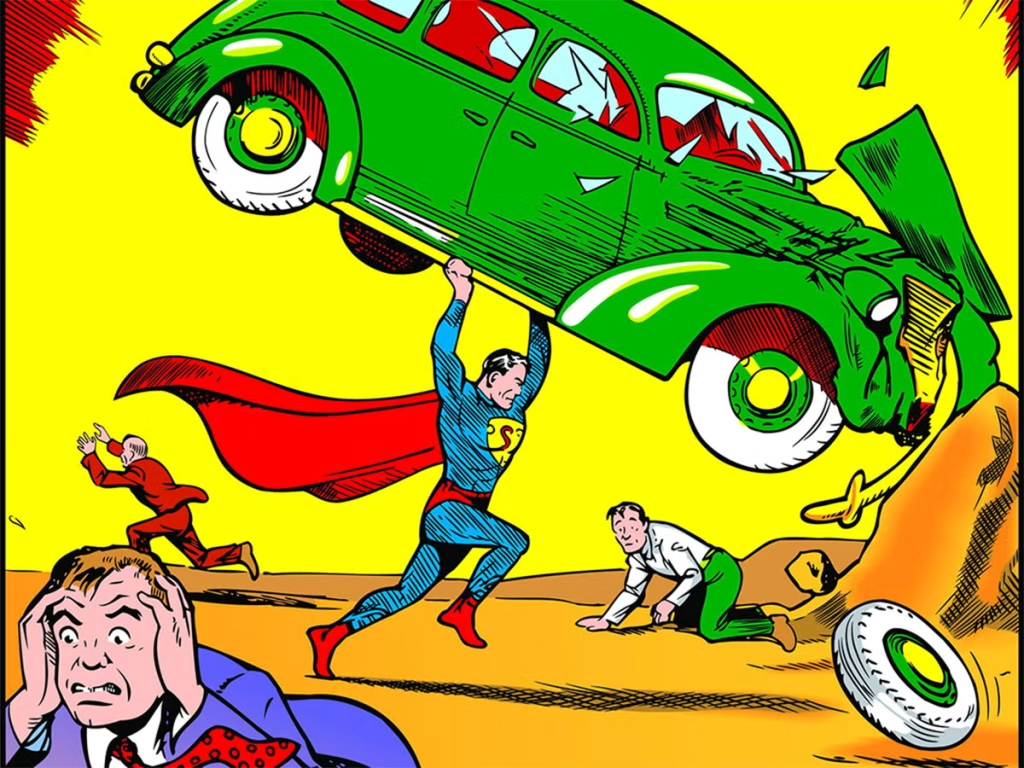
Cover of Action Comics #1 by DC Comics

This series of posts was inspired by the Popsmart Instagram series Films for Fighting Fascism by Professor Shannon Mancus. She’s much smarter than I am and has more degrees than I do but I bet I’ve read more comics than her.

The Creation of Superman Fought Fascism

In 1938, two Jewish men from Cleveland debuted a character in a comic book titled Action Comics #1. Jerry Siegel was the writer and Joe Shuster was the artist. At the time, in Germany, the Nazi regime had bastardized the concept of the Übermensch from Friedrich Nietzsche to justify racial supremacy. The two comic creators subverted this idea and named their character Superman. It was an obvious attempt to redefine what might be considered “superior” in the minds of the world.

The creators imagined someone strong enough to stop evil the moment the hero sees it. Superman was built to defend the most vulnerable. He is a protector who sides with the underdog, fights tyranny, and stops corruption.

The Nazi party actually noticed this subversion. In 1940, the official SS newspaper, Das Schwarze Korps, published a vitriolic attack on Jerry Siegel, calling him an “intellectually and physically circumcised chap” and mocking Superman as a Jewish fantasy. The creators’ act of creation was so powerful it drew direct fire from the Third Reich before America even entered the war.

To even entertain the notion that Superman would kowtow to an authoritarian regime, or any government with strict dictates against freedom of thought and expression is farcical on its face.

Yet even today there are those on the political right who claim that Superman is meant to be a stoic character, god-like, who is not only physically but emotionally invulnerable. One who would never crack a smile, cry at the death of a loved one, or become angry at the United States government shooting protestors in the streets. The premiere issue of Action Comics debunks all of that.

In his first comic, Superman fights corrupt politicians, domestic abusers, and corporate fat-cats. In essence, Superman was a New Deal Democrat right from the start. He was seen as the hero who could put a halt to fascism, not one who might uphold it. He didn’t start with god-like powers either. Yes, he was stronger than the average man and invulnerable to bullets. But there were limits. He could not yet fly. He could take large leaps. He could lift cars above his head without trouble. Yet there was no indication his strength was limitless. Nor has there ever been the indication that Superman can’t be hurt, bleed, or even die in all of his long history.

While acting stoic and showing no empathy at the suffering of others from authoritarian aligned people might on the surface look “manly” and hero-like, it is not. That is just performance. One of the first and most crucial tools of tyranny is to dehumanize others. The only way to do that is to remove our empathy for one another. To remove our community and act as if we don’t feel the pain of those in need is the goal of all authoritarian regimes. Often that starts by encouraging hypermasculine attitudes as if showing emotions is a weakness rather than a universal human experience.

Superman is a true hero to and for the people. He’s an immigrant from a dead culture who sought refuge in America. Upon arrival he immediately began contributing to society and helping people. Rather than seeing humans as alien in his Kryptonian view of the world, he strives to become the most human amongst us.

Superman Continued to Fight Far Right Agendas Long After Action Comics #1

In comparison to other comic book characters of the World War II era, Superman was a little slow to join the fight in an overt manner. But when he did join the fray, it happened even before Captain America famously punched Hitler on the cover of his 1940 debut. Instead of a standard comic issue, the creators of Superman published an imaginary story in Look Magazine depicting how the hero could end the war. It might have been more bold to put the story into Action Comics but it was still a poke in the eye of the Nazi regime. But his fight against those with ridiculous ideas of racial superiority didn’t end there.

Just after the war, Superman was hugely popular and had his own radio show. In 1946, the Adventures of Superman radio show ran the “Clan of the Fiery Cross” storyline. Activist Stetson Kennedy had infiltrated the KKK, learned their secret code words, rituals, and hierarchy, and passed the information to the show’s producers. By exposing the Klan’s ridiculous secret handshakes and titles on a massive children’s broadcast, the show stripped away the mystique and terror of the group. It humiliated them, destroyed their recruitment numbers, and mobilized the community against them.

Gene Luen Yang, a Bay Area comic book creator best known for American Born Chinese, has a fantastic and fascinating graphic novel loosely based on the Clan of the Fiery Cross storyline titled Superman Smashes the Klan. Written in 2019 the book proves Superman is as against hatred now as he has ever been.

In Action Comics #900 (2011), Superman actually renounced his US citizenship because he was tired of his actions being used as political policy by the US government after he walked with peaceful protestors in Iran. While some on the right viewed this as being un-American, Superman was exercising one of our most fundamental freedoms as Americans. The right to peacefully assemble. A right the government in Iran is still suppressing even now. Superman, at this point, realizes that even American government can be led towards authoritarianism and he is a symbol more meaningful than any single government. As our own government shoots protestors, it is reassuring to know if Superman were real, he would be in the streets protesting with us.

Absolute Superman is a current title featuring an alternate universe in which Superman is directly confronting billionaires, using his empathy to try to understand the world today, and taking action. Again he displays radical empathy. He’s intensely affected by the pain and deaths of those around him. The most current iteration of the character is still doing what he did in his debut comic.

The act of reading these stories alone is a tool against fascism. These stories teach us that the most heroic of heroes is one that feels emotional depth, understands those in need, and then does something about it. No matter the cost to himself. Yes, he is physically invulnerable to most things. However, losing one life of any human is more devastating to Clark Kent/Superman than dying from kryptonite poisoning.

Some people have criticized the most recent film adaptation of the character as showing him being too kind. With Superman that is literally impossible. His whole character is radical empathy and meaningful kindness. And his hope is to spread this kindness to the world.

Superman Creates Community

By DC Comics – DC Comics, Fair use, https://en.wikipedia.org/w/index.php?curid=78165388

If you look at the long history of the world’s most famous superhero you will see that he believes in hope for others so strongly he himself becomes a symbol of hope in the real world. The S shield that he wears on his chest is one of the most universally recognized symbols on the planet.

Young kids in Kansas in 1946 could wear that symbol on their chests believing there was hope to stomp out the KKK. People in Iran can wear the symbol believing Superman would stand with them in a fight for an equal society. Because he did. And we, as Americans, can march in the streets wearing his symbol, knowing it is one of hope that stands against government overreach.

Superman doesn’t just care about those he fights for either. He cares about those he fights against. He has the power to snuff out any human life in the blink of an eye. Yet this hero has a long-running arch nemesis whom he cares deeply about. Lex Luthor has come in many forms from mad scientist, to corrupt business mogul, to scheming politician. Yet he lives. Why? Because fundamentally, at his core, Superman has hope. He has hope that even the worst of us, those of us who have wronged others, and are self-dealing have the capacity to be better.

Fighting fascism means building community. This means there are going to be times when we have to realize people have the capacity to change. While we should hold people accountable for their actions, there are those caught in the grip of an authoritarian movement right now in America that will need us all to display Superman’s greatest strength. His radical empathy and sense of community.

A List of Standout Superman Stories for Fighting Fascism

If you want to dive deeper into the history, the anti-authoritarian roots, and the radical empathy of the Man of Steel, add these ten essential stories to your reading list. Most of these you can find on DC Universe Infinite if you have it. My preferred method is checking them out from your local library. I’ve added the links for convenience but they are not affiliate or sponsored links.

1. Action Comics #1–10 (1938)

  • By: Jerry Siegel and Joe Shuster
  • The Blueprint: The original Golden Age run where Superman acts as a New Deal populist, directly fighting corrupt politicians, slumlords, domestic abusers, and corporate profiteers who oppress everyday citizens.
  • Read it here: DC Universe Infinite – Action Comics #1

2. Look Magazine – “How Superman Would End the War” (1940)

  • By: Jerry Siegel and Joe Shuster
  • The Blueprint: The historic, two-page feature story where the creators bypassed US neutrality laws to show Superman flying to Berlin, demolishing the Nazi war machine, and dragging Hitler to the League of Nations.
  • Read it here: Internet Archive – Look Magazine

3. The Adventures of Superman Radio Show – “Clan of the Fiery Cross” (1946)

  • The Blueprint: The groundbreaking 16-part radio serial that weaponized real-world Ku Klux Klan secrets, codes, and rituals to humiliate the hate group, tank their recruitment numbers, and build community resistance.
  • Listen to it here: YouTube Playlist – Clan of the Fiery Cross

4. Superman Smashes the Klan (2020)

  • By: Gene Luen Yang and Gurihiru
  • The Blueprint: A brilliant modern graphic novel adaptation of the 1946 radio show. It explores bigotry, immigrant identity, and structural racism through the eyes of a Chinese-American family in Metropolis and a young Clark Kent coming to terms with his own alien heritage.
  • Read it here: DC Universe Infinite – Superman Smashes the Klan

5. Action Comics #775 – “What’s So Funny About Truth, Justice & the American Way?” (2001)

  • By: Joe Kelly, Doug Mahnke, and Lee Bermejo
  • The Blueprint: Superman faces off against a cynical, violent team of anti-heroes called The Elite. It stands as the ultimate rebuttal to anyone who claims Superman should be a cold, executioner-style god, proving that his restraint is a deliberate choice to reject authoritarian power.
  • Read it here: DC Universe Infinite – Action Comics #775

6. All-Star Superman #10 – “Never-Ending” (2008)

  • By: Grant Morrison and Frank Quitely
  • The Blueprint: A masterpiece of emotional scale. Facing his own mortality, Superman spends his time protecting the micro-details of the planet, culminating in a legendary, life-saving act of pure empathy for a lonely teenager.
  • Read it here: DC Universe Infinite – All-Star Superman #10

7. Action Comics #900 – “The Incident” (2011)

  • By: David S. Goyer and Miguel Sepulveda
  • The Blueprint: The controversial and powerful short story where Superman renounces his U.S. citizenship to prevent the federal government from using his personal, anti-authoritarian actions—like walking with peaceful democratic protestors in Iran—as state policy.
  • Read it here: DC Universe Infinite – Action Comics #900

8. Superman: Peace on Earth (1998)

  • By: Paul Dini and Alex Ross
  • The Blueprint: A stunning graphic novel exploring the limits of power. Superman attempts to spend a day feeding the starving populations of the world, only to discover how dictatorial and militarized regimes weaponize human deprivation to stay in control.
  • Read it here: Goodreads – Superman Peace on Earth

9. Absolute Superman (2024–Ongoing)

  • By: Jason Aaron and Rafa Sandoval
  • The Blueprint: The most current, modern run reimagines Kal-El without his usual safety nets. Left to navigate a cruel world alone as a blue-collar immigrant, he uses his radical empathy to directly confront exploitative corporations, corrupt systems, and billionaires.
  • Read it here: DC Comics – Absolute Superman Hub

10. Superman Red & Blue (2021)

  • By: Various Creators
  • The Blueprint: An anthology series stripping the character down to his core traits. It focuses entirely on everyday kindness, showing how a person with unlimited physical strength uses small acts of solidarity to mend broken communities and instill hope.
  • Read it here: DC Universe Infinite – Superman Red & Blue (2021)

Next Time

My next post in this series will be on Maus by Art Spiegelman.

Marvel 616 Review – Journey Into Mystery #95

Journey Into Myster #95
Journey Into Myster #95 Photo Credit: Marvel, Writers: Stan Lee, Robert Bernstein, Artist: Joe Sinnott

In Journey Into Mystery #95 the only thing Thor has to fear is Thor himself as he takes on his diabolical double! That’s right, Thor has to fight a version of himself in this issue. It gets pretty wild but more for the setup than the action. And what’s more, the other Thor has not one but two magic hammers. So what’s going on here? How did Thor get into this predicament?

The start of the issue gives us a teaser page with Thor in disbelief over the evil double of himself attacking with two hammers. But the story itself begins in Asgard. Odin has summoned Thor back to the land of the Norse gods because there is a terrible drought. Thor can literally make it rain so he taps his magic hammer twice on the ground and a thunder storm begins. Thor tells Odin it will last for seven days. On the seventh day he’ll come back, stamp the hammer on the ground three times and the storm will end.

Thor then returns to Earth telling Odin he has to help a human with a vital science experiment. Heimdall watches Thor as he flies over the rainbow bridge and Thor muses about how he would stay in Asgard if he wasn’t so used to humans.

When Thor gets to Earth he heads to a science convention where a scientist named Professor Zaxton is about to give a demonstration. Dr. Don Blake, Thor’s other identity, has invented an android. I still find Thor to be the superhero least in need of any kind of secret identity but apparently Dr. Blake is not just a good medical doctor. He’s so good at science he can create an android duplicate of a human. But he’s decided to let another scientist run the demo.

Professor Zaxton is all set to do his demonstration. When Thor shows up he demonstrates how he can rip apart a safe. Inside the safe is a green android. Zaxton uses a remote control to make the android move. Then he has another scientist put up an impossible math equation. The android solves it. Blake built the android to have an I.Q. of 375 “…twice that of the brightest human being!”

But this thing is not just smart, its strong too. Thor whacks it a couple times with his hammer but the thing takes no damage. Blake designed this thing with impenetrable skin. And Zaxton goes on to describe how these things could survive a nuclear blast and be used as ultra-intelligent soldiers. But Zaxton does something to the remote control and the android says his entire mechanism is being short circuited.

The android is on the brink of explosion. Zaxton figures that’s fine because the skin is impenetrable so it will only explode on the inside. But Dr. Blake also made the interior of the android with the same material. The android tells Zaxton that when he explodes his skin will disintegrate like shrapnel. Not ideal. Zaxton begs Thor to do something.

Thor, being the hero, wraps the android up in steel left over from the safe and hurls the android into the sky. I guess we’ll just ignore all the debris and impact that will come back down to Earth. This incident ends the demonstration. Thor goes back to Blake’s office and turns human again. But he’s quite annoyed with Zaxton. He suspects the man sabotaged the demonstration.

When Don Blake comes out of the office, Professor Zaxton is waiting for him. Zaxton has his own invention in hand. Blake tells Zaxton he heard about the botched demonstration. He also asks Zaxton how he could be so stupid. Zaxton just goes on demonstrating a duplicating machine. He makes a duplicate of the office couch. He duplicates the typewriters. But he does need Blake’s help to perfect the machine. Zaxton wants Blake to help him duplicate human beings. Blake tells him he can’t tamper with human life. I do have to say, the android Blake made was pretty close to doing that on it’s own but we’ll let that go.

At first, Blake refuses to help. But Zaxton reveals he has taken Blake’s nurse (and love interest) hostage. Blake has to help now. Zaxton also admits he did deliberately destroy the android out of jealousy. He just didn’t think the explosion would hurt him. Blake thinks about changing to Thor and forcing her whereabouts out of Zaxton but he says, “…it’s against my code to harm human beings except in self defense!” I’m not sure how accurate that statement is given some of his past adventures.

Blake agrees to help Zaxton but he’s mostly buying time. The good doctor fixes up the machine. He figures he’s done but Zaxton won’t tell him where Jane is until he’s made sure the machine works. They go out in the street. Zaxton uses the machine on an alley cat. It works just fine. Blake demands to know where Jane is. Zaxton tells him she’s locked in the cellar of his house.

Blake decides to change into Thor and rescue Jane. But Zaxton sees him do it. This is the first human to know Thor has a dual identity. What does Zaxton do? No surprise, he duplicates Thor. Turns out this machine doesn’t just duplicate people. It also creates the opposite personality of the person duplicated. And these duplicates are under Zaxton’s telepathic control.

Thor tries to smash the machine but his duplicate protects Zaxton. And to make it more of a challenge, Zaxton duplicates Mjolnir for the evil double. A fight ensues. Zaxton confesses he is after absolute power. Zaxton tries everything he can to slow Thor down, including duplicating a building so Thor crashes into it. Thor throws his hammer at the duplicate but Zaxton makes another Thor just to absorb the impact. This one disappears after the hammer hits. But there is still the first duplicate to take care of.

Zaxton duplicates a plane so Thor has to block his duplicate’s hammer throws to save innocent lives. But these hammer hits do nothing to Thor. Can you guess why? Yep, the duplicate is not worthy.

Thor hits his duplicate with the real Mjolnir and the duplicate disappears. To save himself, Zaxton makes a duplicate of himself. But right after that, the real Zaxton slips and falls onto a highway. Thor tries to save him but he’s not fast enough. But this is convenient for Thor. Now there is a good version of Zaxton walking around. And he has no idea Thor is actually Dr. Donald Blake.

And in the next panel we get what is so far my absolute favorite narration of all of the Thor stories. “After Thor disposes of the dead man and frees Jane Foster…” I love the casual mention of a Norse god just tossing a body like he’s a mob boss.

True to his word, Thor returns to Asgard and ends the storm there.

All in all this was a pretty silly story and it took quite a few odd turns. I thought the android was going to be the Thor duplicate but instead we had yet another evil scientist in Marvel 616. And the scenes in Asgard seemed entirely unnecessary but I’m sure they were trying to fill up enough pages.

Next up we’re getting small again as we catch up with Ant-Man and The Wasp in Tales to Astonish #46!

P.S. I’ve had a few people ask recently where I am getting my order of issues from. It’s on this awesome website here. And they have reading orders for all kinds of stuff so go check them out!

Marvel 616 Review – Fantastic Four #17

Fantastic Four #17
Fantastic Four #17 Photo Credit: Marvel, Writer: Stan Lee, Artist, Jack Kirby

Fantastic Four #17 continues the story from the last issue. Dr. Doom is now loose in America and our heroes have a lot to contend with. This is the first continuing story in Fantastic Four and it really starts to feel like a connected universe is starting.

The first page juxtaposes a happy Fantastic Four saying farewell to Ant-Man who helped them last issue with an ominous title. In big red letters it says “Defeated by Doctor Doom!” We’ll see about that. We see Ant-Man catapulting away and he will not return this issue. But we’ll catch up with him again soon.

Reed Richards puts away the little launcher he built for Ant-Man and Johnny Storm muses about adding him to the team. The Thing responds it would be an improvement over Johnny. Their bickering is a running theme. But something interesting here is that The Thing is reading an Ant-Man comic as he speaks.

The Thing reads about The Ant-Man

I love it when we get in universe little gags like that. But then in typical early Marvel 616 fashion, they do a flashback of what happened in the previous issue. I’m not going to rehash it here but if you didn’t read my last post, that issue was wild.

Reed then pulls out a complicated contraption as he often does. This is a radar set, “…extra sensitive to human flesh covered by steel!” I hope no one is using steel to cosplay as a knight at the moment. But it should track Doom.

While Reed listens to his signal, the rest of the group split up to scour the city and see if they can find the bad guy. None of them find Doom but The Thing does find a guy in a green cape dressed in armor advertising a movie. There was someone cosplaying as a knight! But it wasn’t Doom.

Johnny has no luck. Sue Storm disrupts what she thinks is an arms deal but turns out to be a toy demonstration. The group meets up to compare notes but no one found anything. When they try to leave the building there is a huge crowd of fans.

A helpful janitor leads the group to a freight elevator. He only asks to shake their hands in return. I bet you know where this is going don’t you? If you thought the janitor was Dr. Doom and he placed a tiny, tissue-thin plastic disc to each of their hands, you were right!

Doom goes back to his headquarters and releases balloon like robots that follow each member of the FF. These things interrupt Johnny’s date, distract The Thing from his date, puts a halt to a photo shoot for Sue Storm, and disrupt an award ceremony for Reed Richards. No matter what the team does, they can’t destroy these things. And they won’t stop following either.

Reed has a gadget that discovers the discs on their hands. They figure out Doom must be monitoring them but the flying robots go away. But this was only the first phase of the bad doctor’s plan.

Doom decides the weak spot in the team is Thing’s girlfriend Alicia who is blind. Doom has a pretty sad moment where he admits he has never fully understood other human beings. And he says, “Even now I cannot comprehend how one as lovely as Alicia can feel affection for the grotesque Thing!!”

He’s bummed someone loves The Thing but not him. Doom has a scarred and damaged face under the mask, although we don’t see it here. Pretty sure it’s not your face, it’s your personality and, you know, obsession with being a horrible person that is the problem, Doom.

Regardless, Doom wants to take revenge. He uses a “grappler ray” to lift Alicia into the air and fly him to his headquarters. His headquarters is a flying base hidden by a cloud.

The Human Torch shows The Thing a newspaper with a picture of Alicia flying in the air. For a smart guy, I really don’t think Doom thought how angry this would make The Thing. Needless to say, he’s big mad.

Doom contacts the team and tells them different ways he plans to terrorize the city. And warns them not to oppose him or Alicia is in trouble. Reed is not afraid. But The Thing is worried something will happen to Alicia.

Doom is not after money, he makes that clear in the next panel. But he sure would like some power. He sends a film reel to the white house threatening war. We even get a panel of JFK’s… forehead. It’s the first time a sitting president is depicted in Marvel 616 comics. And JFK isn’t backing down. He has to put his kid to bed!

Marvel presents, JFK's forehead
Marvel presents, JFK’s forehead

With JFK not responding, Doom wreaks havoc by interfering with all electronic devices and firing off our missiles. These actions disrupt American industry. The Kremlin is thrilled until one of them points out that Doom will come for them next.

Someone from the joint chiefs of staff comes to ask the FF for help but Reed says he already has a plan. But he can’t share it with anyone because he thinks it would be safer just for his team to be in on it. I guess now it doesn’t matter that Doom could be listening?

Reed used his radar to discover Doom’s headquarters and this thing has disintegrator ray guns on it! And those rays will target the FF because the robots that followed them mapped their atomic structure. But Reed Richards is the smartest man alive, so he has a plan.

The Thing has sometimes turned from The Thing to plain old Benjamin Grimm. The plan is to have him take a formula turning him human and then change back to The Thing and go on the attack. It’s a close call but Ben is able to get onto the headquarters just before he turns back into The Thing. He tosses out the disintegrator ray gun and his pals can now come on up and help too.

They split up, looking for Doctor Doom. Doom traps The Human Torch in a spinning room that douses his flames. Reed finds himself trapped in a room that fills up with wet cement. But he can escape because he can make himself thin enough to “fit thru the pockets of porous cement.” The Thing falls down a hole with a greased pole that could drop him all the way back to the city. But he manages to claw his way back up.

The three team members meet up together but Doom launches power spheres at them. Not real clear what these do but it can’t be good. Somehow they are supposed to transfer the heroes to a different dimension.

But Doom had it all wrong. Those figures were flame images created by The Human Torch. The Thing demands Doom tell him where Alicia is. The Invisible Girl finds her first. And she hatches a plan. She trades places with Alicia. I think it would have been smarter to hide Alicia and turn invisible in the first place. Instead she turns invisible when Doom enters the room. There is a scuffle but Sue Storm wins because Doom should not, “…ever forget that I was taught Judo by one of the world’s greatest experts: Reed Richards!” This guy can do anything.

Just as Doom thinks he will overcome Sue, the rest of the team bursts in. And boy is Ben Grimm pissed. Doom jumps out of his flying headquarters. I’m sure that’s the end of him.

The issue ends with Doom gone and the team and Alicia reunited. Doom is an impending threat but he’s gone for the moment.

This issue was not as thrilling or wild as the last one. But it is a decent story with a few really fun moments. Doctor Doom proves to be a competent villain by escaping at the right time. And the world feels a little more real in the story with the involvement of the white house.

I’m sure we’ll return to Doctor Doom soon but for the moment we are leaving the Fantastic Four.

Net up on the reading list we check back in with the god of thunder himself, Thor, in the pages of Journey Into Mystery #95!

Usagi Yojimbo – Comic Book Recommendation

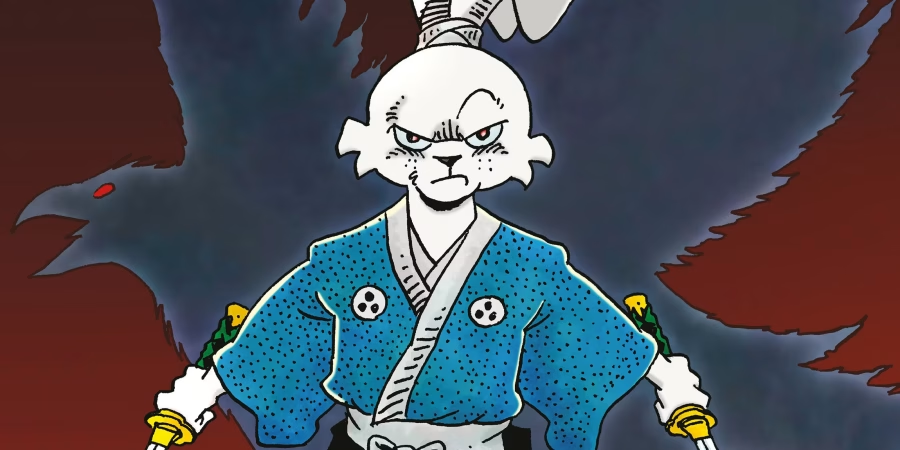
Usagi Yojimbo by Stan Sakai

Usagi Yojimbo is one of the most complex and sweeping samurai epics of all time. This book has been published since 1984 and it is still going. If you are looking for a great comic book read that is not a superhero comic, Usagi Yojimbo stands tall as one of the best ever made. While it has its legion of fans, the comic is often overlooked by new readers because it looks a bit cartoonish and cutesy. Much like Bone which is cute on the surface but is truly a massive fantasy epic, with Usagi you get far more than it looks like on the cover.

(Note: this post contains affiliate links. If you purchase something through this post I will get a small commission at no extra cost to you)

What is Usagi Yojimbo about?

The word Usagi means rabbit. Yojimbo means bodyguard. That’s a pretty good description of what this is about. But there is so much more to it. This is set at the beginning of the Edo period in Japan when the country was just coming under the rule of the shogunate and people were still feeling battle scars from recent history.

Each story follows Usagi on an adventure where he often protects the innocent or rights some wrong. Reading the books gives the same feeling you get when watching some of the greatest Akira Kurosawa samurai films.

There is an expansive cast of characters, several who come and go, and some who you meet only once and never again. A larger story line exists in the series. But it is possible to pick up any volume of the series and get an entire story.

My only word of caution here is to be careful about giving it to very young kids. There is nothing explicit here but there is some blood. And considering this is a samurai story, characters die. Generally, it’s fine for almost all audiences though.

How do I get started?

There is a long and complicated publishing history to this comic. It’s gone through several publishers. The character has always belonged to the creator, writer and artist Stan Sakai, but he’s moved Usagi to a few different spots for different reasons. Lucky for us, however, the numbering of the series is pretty straightforward. There are over 40 numbered volumes plus some omnibus editions and other volumes and crossovers that pop up here and there.

While I think you can really jump in anywhere, as long as you are reading a collected story, I think the best volume to begin with is Usagi Yojimbo, Book 1: The Ronin. This collects the earliest comics and starts out the proper story. If you start here and read through, you also get to see the progression of Sakai’s art style. It takes him just a bit to land on the tone he wants but once this gets going, it is a jaw dropping body of work.

You can get the first volume on Amazon by clicking the image above or the link here. It’ll cost you $19. If you buy through one of my links it really helps out this blog without any extra cost to you.

If you have a lot of cash to burn and you know you want to get in to Usagi, there is also the Usagi Yojimbo: The Special Edition: 2 Volume Hardcover Box Set. That will set you back at least $116 though. You can get the paperback version for $99. The nice thing about this set is you get the first seven Usagi stories plus some extra artwork and cover gallery. It’s a big price tag though. But if you want it you can grab it right here.

Usagi Yojimbo conclusion

Ready to settle in for a great long read that will transport you back to Edo Japan, full of depth, action, and an unforgettable cast of characters? Usagi Yojimbo is perfect for that. Stan Sakai’s epic is one of the most brilliant comics ever made. Look past the cuteness of the character if that is not your thing. And if it is, then embrace it because there is lots of cuteness too! But either way this is an incredible comic which I simply cannot recommend enough.

Give it a read and let me know what you think!

P.S. want to see some of my superhero comic reviews? Take a look at my series on the Marvel 616 comics here!

Comic Book Recommendation – Peanuts

The Complete Peanuts: Volume 1
Comic Book Recommendation - Peanuts
The Complete Peanuts Volume 1

Because today feels like the kind of day we could all use something wholesome and funny and beloved, I thought I would recommend a comic book. My comic book recommendation – Peanuts needs no advertisement from me. But any time I need to turn to something that is guaranteed to put a smile on my face? I turn to Charles M. Schulz. I’m sure you’ve seen Peanuts cartoons or read some comics in a newspaper or had a volume or two starring Snoopy. But I’m going to talk about my favorite way to read these comics. In complete volumes.

(Note: this post contains affiliate links. If you purchase something through this post I will get a small commission at no extra cost to you)

What is Peanuts about?

Put simply, Peanuts comics are about a group of kids who hang out together. The focus is usually on Charlie Brown who tends to run into a lot of bad luck. The most popular character in the series is his adorable dog, a beagle named Snoopy. We see his escapades as he tries (and often fails) to do normal kid things like fly a kite, win a baseball game, and kick a football.

It sounds simple but because Peanuts comics were around for fifty years in newspapers, there is a ton of material to enjoy. There is actually no need to read them in any particular order at all. And any one strip of Peanuts is almost guaranteed to put a smile on your face. But you probably know all of that already.

What you might be a little less familiar with are some of the older strips. These show the characters a little younger than we’re used to. And they introduce us to future mainstays like Woodstock and Schroeder. Virtually all of the comics are meant to give you a laugh but there are some very sweet and touching moments along the way.

In the earliest volumes the kids are just a bit meaner to each other than they tend to be in later years. But it’s still an amazing read and really fun.

How do I get started?

I’ve read most of the Peanuts comics. I can’t say I’ve definitely read every one because there is just such a big volume to them. But the complete volumes are about as close as you can get to make sure you’ve read the bulk of the work. The physical copy comes in a bit of an oddly shaped version. It’s 8.66 x 1.34 x 6.77 inches. This is like half the height of a normal book and it extends out a good bit. They fit three of the daily strips per page. So it sits a bit awkward on a bookshelf. But it’s a great book to lay on a coffee table or something like that. And I promise, if you leave it out, someone will pick it up and read it.

If you want to get started, I’d recommend starting literally anywhere with these books. Buy any volume from 1-26 and you’ve got a great comic in your hand.

But to make it easy I’ll just link to the first volume here. It’ll cost you around $27 bucks for the hardcover. Cheaper if you get it on Kindle.

If ya wanna be a pal, consider using one of the links in this blog when you get it!

And just to give you a taste, here’s a little sample.

In conclusion

Sometimes you just need a good laugh. Peanuts always provides that. It’s genuinely wholesome and always a fun read. You can read just a single strip or a whole collection any time and you’ll probably feel just a little better inside. It’s the small things sometimes.

Anyway, I hope you check out Peanuts if you haven’t or if it’s been a while. You’ll enjoy it.

P.S. Want another comic book recommendation? Check out The Goon!

The Goon – Comic Book Recommendation

Comic Book Recommendation - The Goon by Eric Powell is a humorous mix of mobsters, zombies, giant squids, weird stories and supernatural phenomena that highly entertains.
The Goon by Eric Powell

I review a lot of super hero comics on this blog. I love those. But there are so many more comics out there and many of them are worth reading. So, I decided I will be giving some recommendations here on comics worth reading that are not super hero comics. The first is my comic book recommendation – The Goon. It’s created by Eric Powell and has recently celebrated its 25th anniversary. Yet, I hardly see it talked about.

(Note: this post contains affiliate links. If you purchase something through this post I will get a small commission at no extra cost to you)

What is The Goon about?

The titular Goon is a big tough mob enforcer type who’s just a regular guy. He hangs out with his buddy Franky and knows everyone in town. But there’s a rival gang of zombies who all hate the Goon and want to see him dead.

The stories are full of humor, violence, gore and oddball things like giant squids and fishmen who are also gangsters. There are plenty of gross out moments in the books so if you don’t find that funny or you are too squeamish for some splattery yet cartoonish gore, this won’t be for you.

There are also moments where the series gets some surprisingly touching moments as well. It gets pretty weird too. There are talking chainsaws, people rising from the dead, jokes about inflatable chickens, and just about everything you could imagine in here.

And while the concept is fun and odd and my type of read, what I think really makes it stand out is the utterly incredible artwork. Eric Powell more or less takes his time with this one and for that reason it tends to look amazing. I’ll give you a couple images below so you can see what I am talking about.

Image of a spooky house in The Goon comic

See how evocative and moody the above image is? It fully immerses us in the time period of the 1930s and brings up feelings of dread and impending doom. Now contrast that with the wild image below. It’s full of bright colors, over the top action, and quippy humor. Powell is able to straddle styles and fit moods in appropriate places while maintaining high quality artwork. It’s truly amazing to behold.

Hopefully that sells you on reading this but there’s a 25 year backlog of this comic so you might be thinking…

How do I get started?

The nice thing about this series is it’s not too overwhelming. At present there are around 54 issues of the first series of The Goon. The second series has at least 12 issues. But there are some spinoffs and one shots and things like that as well. And there are multiple ways to get started with it. The stories are generally self contained so you can pick up any trade paperback and be at a pretty good starting point. But there is a larger story so it can be fun to start from the beginning.

Here’s a whole guide put together by  Trevor Van As with some insightful comments on content warning as well. There are some single issues missing from this as Eric Powell is still making new comics for the series.

While I think the so called, Fancy Pants editions are pretty neat, they have to be purchased on eBay so the price tends to run a bit high.

You could also start with the first trade paperback called The Goon Volume 1: Nothin’ But Misery which collects issues 1-4 plus a short story. This will run you $22 for a physical copy.

But that’s not the best deal because the first omnibus called The Goon: Bunch of Old Crap an Omnibus Volume 1 is just a few bucks more at $35. And it collects four of the trade paperbacks The Goon: Rough Stuff, The Goon: Nothing But Misery, The Goon: My Murderous Childhood, and The Goon: Heaps of Ruination. It’s even cheaper if you get it on Kindle for $10.99.

If ya wanna be a pal, consider using one of the links in this blog when you get it!

In Conclusion

I’ll be recommending more comics here, both superhero and non-superhero so if this one doesn’t float your boat, I’ll probably find one you will like later. But if you like funny comics, horror comics, great art, a bit of crude humor and some mob style enforcers in your stories, plus a healthy dose of weirdness, well, The Goon more than has you covered. And did I mention it has won five Eisner awards? In other words, this is a well regarded comic even among other comic creators.

Give it a read and let me know what you think!

P.S. want to see some of my superhero comic reviews? Take a look at my series on the Marvel 616 comics here!

Rogue One: Cassian & K-2SO Special


Rogue One: Cassian & K-2SO Special Photo Credit: Marvel Writer: Duane Swierczynski, Artist: Fernando Blanco, Colorist: Marcelo Maiolo, Letterer: 
Clayton Cowles, Cover Artist: Julian Totino Tedesco
Rogue One: Cassian & K-2SO Special Photo Credit: Marvel Writer: Duane Swierczynski, Artist: Fernando Blanco, Colorist: Marcelo Maiolo, Letterer: Clayton Cowles, Cover Artist: Julian Totino Tedesco

One of the most amazing things about Star Wars is whenever we see a story we wonder, how did we get here? And Star Wars is always willing to answer that question. We know where Darth Vader comes from because people wanted to know and George Lucas had an answer. A lot of times this works exceedingly well. The film Rogue One: A Star Wars Story is one of the best examples of this. I didn’t know I needed that story but I was blown away by it. Andor the television series is another example.

The Star Wars comics have even more room to tell stories to fill in gaps. I was curious about the Rogue One: Cassian & K-2SO Special comic so I decided to give it a read. Like almost all of the cannon Star Wars comics the artwork is incredible. My favorite way to read is to throw on the soundtrack from one of the movies and make it feel even more immersive. It’s like I have gone to a galaxy far, far away.

As far as the artwork of the piece, I have no notes, It’s perfect. As for the story, well, that’s a little different. It’s not that this is a bad story. There’s a good amount of action. There are characters who communicate by emitting smells which is something I have not seen before in Star Wars. And there are good, funny quips and dialogue like you might expect. I felt like there could be a lot of potential with those two olfactory characters but there’s not really time here to go into their backstory and it doesn’t feel like we’ll be seeing them again anytime soon so they do end up feeling a bit wasted.

The problem with the story is that it is a story we don’t necessarily need. I never wondered how Cassian ended up with K-2SO. It doesn’t bother me that I have an answer to that question but the oversaturation of Star Wars is a bit of a problem. I’d rather we have an all new comic story about characters we haven’t met than this one. In the same way explaining the fuzzy dice on the Millenium Falcon in Solo feels unnecessary, so does this story. It’s a little indulgent but still fun.

Still, if you love Star Wars, there are much worse ways to spend 15 minutes of reading time.

In conclusion, if you are looking for an entertaining Star Wars read with amazing art that has a story with fairly low stakes (we know who will live here) then this is a good comic. And there is only the one shot so once you’ve read it you are done with this particular story.

May the force be with you!

P.S. if you want to check out another of my Star Wars reviews, take a look here.