Journey Into Myster #95 Photo Credit: Marvel, Writers: Stan Lee, Robert Bernstein, Artist: Joe Sinnott
In Journey Into Mystery #95 the only thing Thor has to fear is Thor himself as he takes on his diabolical double! That’s right, Thor has to fight a version of himself in this issue. It gets pretty wild but more for the setup than the action. And what’s more, the other Thor has not one but two magic hammers. So what’s going on here? How did Thor get into this predicament?
The start of the issue gives us a teaser page with Thor in disbelief over the evil double of himself attacking with two hammers. But the story itself begins in Asgard. Odin has summoned Thor back to the land of the Norse gods because there is a terrible drought. Thor can literally make it rain so he taps his magic hammer twice on the ground and a thunder storm begins. Thor tells Odin it will last for seven days. On the seventh day he’ll come back, stamp the hammer on the ground three times and the storm will end.
Thor then returns to Earth telling Odin he has to help a human with a vital science experiment. Heimdall watches Thor as he flies over the rainbow bridge and Thor muses about how he would stay in Asgard if he wasn’t so used to humans.
When Thor gets to Earth he heads to a science convention where a scientist named Professor Zaxton is about to give a demonstration. Dr. Don Blake, Thor’s other identity, has invented an android. I still find Thor to be the superhero least in need of any kind of secret identity but apparently Dr. Blake is not just a good medical doctor. He’s so good at science he can create an android duplicate of a human. But he’s decided to let another scientist run the demo.
Professor Zaxton is all set to do his demonstration. When Thor shows up he demonstrates how he can rip apart a safe. Inside the safe is a green android. Zaxton uses a remote control to make the android move. Then he has another scientist put up an impossible math equation. The android solves it. Blake built the android to have an I.Q. of 375 “…twice that of the brightest human being!”
But this thing is not just smart, its strong too. Thor whacks it a couple times with his hammer but the thing takes no damage. Blake designed this thing with impenetrable skin. And Zaxton goes on to describe how these things could survive a nuclear blast and be used as ultra-intelligent soldiers. But Zaxton does something to the remote control and the android says his entire mechanism is being short circuited.
The android is on the brink of explosion. Zaxton figures that’s fine because the skin is impenetrable so it will only explode on the inside. But Dr. Blake also made the interior of the android with the same material. The android tells Zaxton that when he explodes his skin will disintegrate like shrapnel. Not ideal. Zaxton begs Thor to do something.
Thor, being the hero, wraps the android up in steel left over from the safe and hurls the android into the sky. I guess we’ll just ignore all the debris and impact that will come back down to Earth. This incident ends the demonstration. Thor goes back to Blake’s office and turns human again. But he’s quite annoyed with Zaxton. He suspects the man sabotaged the demonstration.
When Don Blake comes out of the office, Professor Zaxton is waiting for him. Zaxton has his own invention in hand. Blake tells Zaxton he heard about the botched demonstration. He also asks Zaxton how he could be so stupid. Zaxton just goes on demonstrating a duplicating machine. He makes a duplicate of the office couch. He duplicates the typewriters. But he does need Blake’s help to perfect the machine. Zaxton wants Blake to help him duplicate human beings. Blake tells him he can’t tamper with human life. I do have to say, the android Blake made was pretty close to doing that on it’s own but we’ll let that go.
At first, Blake refuses to help. But Zaxton reveals he has taken Blake’s nurse (and love interest) hostage. Blake has to help now. Zaxton also admits he did deliberately destroy the android out of jealousy. He just didn’t think the explosion would hurt him. Blake thinks about changing to Thor and forcing her whereabouts out of Zaxton but he says, “…it’s against my code to harm human beings except in self defense!” I’m not sure how accurate that statement is given some of his past adventures.
Blake agrees to help Zaxton but he’s mostly buying time. The good doctor fixes up the machine. He figures he’s done but Zaxton won’t tell him where Jane is until he’s made sure the machine works. They go out in the street. Zaxton uses the machine on an alley cat. It works just fine. Blake demands to know where Jane is. Zaxton tells him she’s locked in the cellar of his house.
Blake decides to change into Thor and rescue Jane. But Zaxton sees him do it. This is the first human to know Thor has a dual identity. What does Zaxton do? No surprise, he duplicates Thor. Turns out this machine doesn’t just duplicate people. It also creates the opposite personality of the person duplicated. And these duplicates are under Zaxton’s telepathic control.
Thor tries to smash the machine but his duplicate protects Zaxton. And to make it more of a challenge, Zaxton duplicates Mjolnir for the evil double. A fight ensues. Zaxton confesses he is after absolute power. Zaxton tries everything he can to slow Thor down, including duplicating a building so Thor crashes into it. Thor throws his hammer at the duplicate but Zaxton makes another Thor just to absorb the impact. This one disappears after the hammer hits. But there is still the first duplicate to take care of.
Zaxton duplicates a plane so Thor has to block his duplicate’s hammer throws to save innocent lives. But these hammer hits do nothing to Thor. Can you guess why? Yep, the duplicate is not worthy.
Thor hits his duplicate with the real Mjolnir and the duplicate disappears. To save himself, Zaxton makes a duplicate of himself. But right after that, the real Zaxton slips and falls onto a highway. Thor tries to save him but he’s not fast enough. But this is convenient for Thor. Now there is a good version of Zaxton walking around. And he has no idea Thor is actually Dr. Donald Blake.
And in the next panel we get what is so far my absolute favorite narration of all of the Thor stories. “After Thor disposes of the dead man and frees Jane Foster…” I love the casual mention of a Norse god just tossing a body like he’s a mob boss.
True to his word, Thor returns to Asgard and ends the storm there.
All in all this was a pretty silly story and it took quite a few odd turns. I thought the android was going to be the Thor duplicate but instead we had yet another evil scientist in Marvel 616. And the scenes in Asgard seemed entirely unnecessary but I’m sure they were trying to fill up enough pages.
Next up we’re getting small again as we catch up with Ant-Man and The Wasp in Tales to Astonish #46!
P.S. I’ve had a few people ask recently where I am getting my order of issues from. It’s on this awesome website here. And they have reading orders for all kinds of stuff so go check them out!
Fantastic Four #17 Photo Credit: Marvel, Writer: Stan Lee, Artist, Jack Kirby
Fantastic Four #17 continues the story from the last issue. Dr. Doom is now loose in America and our heroes have a lot to contend with. This is the first continuing story in Fantastic Four and it really starts to feel like a connected universe is starting.
The first page juxtaposes a happy Fantastic Four saying farewell to Ant-Man who helped them last issue with an ominous title. In big red letters it says “Defeated by Doctor Doom!” We’ll see about that. We see Ant-Man catapulting away and he will not return this issue. But we’ll catch up with him again soon.
Reed Richards puts away the little launcher he built for Ant-Man and Johnny Storm muses about adding him to the team. The Thing responds it would be an improvement over Johnny. Their bickering is a running theme. But something interesting here is that The Thing is reading an Ant-Man comic as he speaks.
The Thing reads about The Ant-Man
I love it when we get in universe little gags like that. But then in typical early Marvel 616 fashion, they do a flashback of what happened in the previous issue. I’m not going to rehash it here but if you didn’t read my last post, that issue was wild.
Reed then pulls out a complicated contraption as he often does. This is a radar set, “…extra sensitive to human flesh covered by steel!” I hope no one is using steel to cosplay as a knight at the moment. But it should track Doom.
While Reed listens to his signal, the rest of the group split up to scour the city and see if they can find the bad guy. None of them find Doom but The Thing does find a guy in a green cape dressed in armor advertising a movie. There was someone cosplaying as a knight! But it wasn’t Doom.
Johnny has no luck. Sue Storm disrupts what she thinks is an arms deal but turns out to be a toy demonstration. The group meets up to compare notes but no one found anything. When they try to leave the building there is a huge crowd of fans.
A helpful janitor leads the group to a freight elevator. He only asks to shake their hands in return. I bet you know where this is going don’t you? If you thought the janitor was Dr. Doom and he placed a tiny, tissue-thin plastic disc to each of their hands, you were right!
Doom goes back to his headquarters and releases balloon like robots that follow each member of the FF. These things interrupt Johnny’s date, distract The Thing from his date, puts a halt to a photo shoot for Sue Storm, and disrupt an award ceremony for Reed Richards. No matter what the team does, they can’t destroy these things. And they won’t stop following either.
Reed has a gadget that discovers the discs on their hands. They figure out Doom must be monitoring them but the flying robots go away. But this was only the first phase of the bad doctor’s plan.
Doom decides the weak spot in the team is Thing’s girlfriend Alicia who is blind. Doom has a pretty sad moment where he admits he has never fully understood other human beings. And he says, “Even now I cannot comprehend how one as lovely as Alicia can feel affection for the grotesque Thing!!”
He’s bummed someone loves The Thing but not him. Doom has a scarred and damaged face under the mask, although we don’t see it here. Pretty sure it’s not your face, it’s your personality and, you know, obsession with being a horrible person that is the problem, Doom.
Regardless, Doom wants to take revenge. He uses a “grappler ray” to lift Alicia into the air and fly him to his headquarters. His headquarters is a flying base hidden by a cloud.
The Human Torch shows The Thing a newspaper with a picture of Alicia flying in the air. For a smart guy, I really don’t think Doom thought how angry this would make The Thing. Needless to say, he’s big mad.
Doom contacts the team and tells them different ways he plans to terrorize the city. And warns them not to oppose him or Alicia is in trouble. Reed is not afraid. But The Thing is worried something will happen to Alicia.
Doom is not after money, he makes that clear in the next panel. But he sure would like some power. He sends a film reel to the white house threatening war. We even get a panel of JFK’s… forehead. It’s the first time a sitting president is depicted in Marvel 616 comics. And JFK isn’t backing down. He has to put his kid to bed!
Marvel presents, JFK’s forehead
With JFK not responding, Doom wreaks havoc by interfering with all electronic devices and firing off our missiles. These actions disrupt American industry. The Kremlin is thrilled until one of them points out that Doom will come for them next.
Someone from the joint chiefs of staff comes to ask the FF for help but Reed says he already has a plan. But he can’t share it with anyone because he thinks it would be safer just for his team to be in on it. I guess now it doesn’t matter that Doom could be listening?
Reed used his radar to discover Doom’s headquarters and this thing has disintegrator ray guns on it! And those rays will target the FF because the robots that followed them mapped their atomic structure. But Reed Richards is the smartest man alive, so he has a plan.
The Thing has sometimes turned from The Thing to plain old Benjamin Grimm. The plan is to have him take a formula turning him human and then change back to The Thing and go on the attack. It’s a close call but Ben is able to get onto the headquarters just before he turns back into The Thing. He tosses out the disintegrator ray gun and his pals can now come on up and help too.
They split up, looking for Doctor Doom. Doom traps The Human Torch in a spinning room that douses his flames. Reed finds himself trapped in a room that fills up with wet cement. But he can escape because he can make himself thin enough to “fit thru the pockets of porous cement.” The Thing falls down a hole with a greased pole that could drop him all the way back to the city. But he manages to claw his way back up.
The three team members meet up together but Doom launches power spheres at them. Not real clear what these do but it can’t be good. Somehow they are supposed to transfer the heroes to a different dimension.
But Doom had it all wrong. Those figures were flame images created by The Human Torch. The Thing demands Doom tell him where Alicia is. The Invisible Girl finds her first. And she hatches a plan. She trades places with Alicia. I think it would have been smarter to hide Alicia and turn invisible in the first place. Instead she turns invisible when Doom enters the room. There is a scuffle but Sue Storm wins because Doom should not, “…ever forget that I was taught Judo by one of the world’s greatest experts: Reed Richards!” This guy can do anything.
Just as Doom thinks he will overcome Sue, the rest of the team bursts in. And boy is Ben Grimm pissed. Doom jumps out of his flying headquarters. I’m sure that’s the end of him.
The issue ends with Doom gone and the team and Alicia reunited. Doom is an impending threat but he’s gone for the moment.
This issue was not as thrilling or wild as the last one. But it is a decent story with a few really fun moments. Doctor Doom proves to be a competent villain by escaping at the right time. And the world feels a little more real in the story with the involvement of the white house.
I’m sure we’ll return to Doctor Doom soon but for the moment we are leaving the Fantastic Four.
Net up on the reading list we check back in with the god of thunder himself, Thor, in the pages of Journey Into Mystery #95!
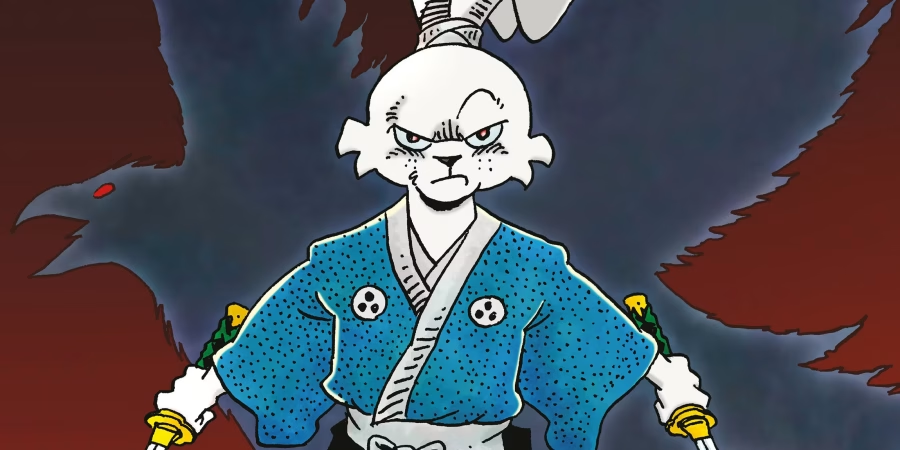
Usagi Yojimbo is one of the most complex and sweeping samurai epics of all time. This book has been published since 1984 and it is still going. If you are looking for a great comic book read that is not a superhero comic, UsagiYojimbo stands tall as one of the best ever made. While it has its legion of fans, the comic is often overlooked by new readers because it looks a bit cartoonish and cutesy. Much like Bone which is cute on the surface but is truly a massive fantasy epic, with Usagi you get far more than it looks like on the cover.
(Note: this post contains affiliate links. If you purchase something through this post I will get a small commission at no extra cost to you)
What is Usagi Yojimbo about?
The word Usagi means rabbit. Yojimbo means bodyguard. That’s a pretty good description of what this is about. But there is so much more to it. This is set at the beginning of the Edo period in Japan when the country was just coming under the rule of the shogunate and people were still feeling battle scars from recent history.
Each story follows Usagi on an adventure where he often protects the innocent or rights some wrong. Reading the books gives the same feeling you get when watching some of the greatest Akira Kurosawa samurai films.
There is an expansive cast of characters, several who come and go, and some who you meet only once and never again. A larger story line exists in the series. But it is possible to pick up any volume of the series and get an entire story.
My only word of caution here is to be careful about giving it to very young kids. There is nothing explicit here but there is some blood. And considering this is a samurai story, characters die. Generally, it’s fine for almost all audiences though.
How do I get started?
There is a long and complicated publishing history to this comic. It’s gone through several publishers. The character has always belonged to the creator, writer and artist Stan Sakai, but he’s moved Usagi to a few different spots for different reasons. Lucky for us, however, the numbering of the series is pretty straightforward. There are over 40 numbered volumes plus some omnibus editions and other volumes and crossovers that pop up here and there.
While I think you can really jump in anywhere, as long as you are reading a collected story, I think the best volume to begin with is Usagi Yojimbo, Book 1: The Ronin. This collects the earliest comics and starts out the proper story. If you start here and read through, you also get to see the progression of Sakai’s art style. It takes him just a bit to land on the tone he wants but once this gets going, it is a jaw dropping body of work.
You can get the first volume on Amazon by clicking the image above or the link here. It’ll cost you $19. If you buy through one of my links it really helps out this blog without any extra cost to you.
If you have a lot of cash to burn and you know you want to get in to Usagi, there is also the Usagi Yojimbo: The Special Edition: 2 Volume Hardcover Box Set. That will set you back at least $116 though. You can get the paperback version for $99. The nice thing about this set is you get the first seven Usagi stories plus some extra artwork and cover gallery. It’s a big price tag though. But if you want it you can grab it right here.
Usagi Yojimbo conclusion
Ready to settle in for a great long read that will transport you back to Edo Japan, full of depth, action, and an unforgettable cast of characters? Usagi Yojimbo is perfect for that. Stan Sakai’s epic is one of the most brilliant comics ever made. Look past the cuteness of the character if that is not your thing. And if it is, then embrace it because there is lots of cuteness too! But either way this is an incredible comic which I simply cannot recommend enough.
Give it a read and let me know what you think!
P.S. want to see some of my superhero comic reviews? Take a look at my series on the Marvel 616 comics here!
Because today feels like the kind of day we could all use something wholesome and funny and beloved, I thought I would recommend a comic book. My comic book recommendation – Peanuts needs no advertisement from me. But any time I need to turn to something that is guaranteed to put a smile on my face? I turn to Charles M. Schulz. I’m sure you’ve seen Peanuts cartoons or read some comics in a newspaper or had a volume or two starring Snoopy. But I’m going to talk about my favorite way to read these comics. In complete volumes.
(Note: this post contains affiliate links. If you purchase something through this post I will get a small commission at no extra cost to you)
What is Peanuts about?
Put simply, Peanuts comics are about a group of kids who hang out together. The focus is usually on Charlie Brown who tends to run into a lot of bad luck. The most popular character in the series is his adorable dog, a beagle named Snoopy. We see his escapades as he tries (and often fails) to do normal kid things like fly a kite, win a baseball game, and kick a football.
It sounds simple but because Peanuts comics were around for fifty years in newspapers, there is a ton of material to enjoy. There is actually no need to read them in any particular order at all. And any one strip of Peanuts is almost guaranteed to put a smile on your face. But you probably know all of that already.
What you might be a little less familiar with are some of the older strips. These show the characters a little younger than we’re used to. And they introduce us to future mainstays like Woodstock and Schroeder. Virtually all of the comics are meant to give you a laugh but there are some very sweet and touching moments along the way.
In the earliest volumes the kids are just a bit meaner to each other than they tend to be in later years. But it’s still an amazing read and really fun.
How do I get started?
I’ve read most of the Peanuts comics. I can’t say I’ve definitely read every one because there is just such a big volume to them. But the complete volumes are about as close as you can get to make sure you’ve read the bulk of the work. The physical copy comes in a bit of an oddly shaped version. It’s 8.66 x 1.34 x 6.77 inches. This is like half the height of a normal book and it extends out a good bit. They fit three of the daily strips per page. So it sits a bit awkward on a bookshelf. But it’s a great book to lay on a coffee table or something like that. And I promise, if you leave it out, someone will pick it up and read it.
If you want to get started, I’d recommend starting literally anywhere with these books. Buy any volume from 1-26 and you’ve got a great comic in your hand.
But to make it easy I’ll just link to the first volume here. It’ll cost you around $27 bucks for the hardcover. Cheaper if you get it on Kindle.
If ya wanna be a pal, consider using one of the links in this blog when you get it!
And just to give you a taste, here’s a little sample.
In conclusion
Sometimes you just need a good laugh. Peanuts always provides that. It’s genuinely wholesome and always a fun read. You can read just a single strip or a whole collection any time and you’ll probably feel just a little better inside. It’s the small things sometimes.
Anyway, I hope you check out Peanuts if you haven’t or if it’s been a while. You’ll enjoy it.
P.S. Want another comic book recommendation? Check out The Goon!
Fantastic Four #16 (Photo Credit: Marvel, Writer: Stan Lee, Artist: Jack Kirby
There is so much to talk about in Fantastic Four #16. This issue brings back one of the best villains in all of comics, is the first meeting between Ant-Man and the team, and introduces Reed and friends to the microverse. While there have already been some fun stories, this is the first time it feels like Fantastic Four has real staying power and begins to tell a connected story for Marvel 616.
The opening page of the issue feels more like a film poster than a comic book page. It’s reminiscent of those amazing B movie posters from the 50s and 60s featuring strange stories about monsters and adventurers. It promises us the return of, “The world’s most dangerous super-villain!”. It has a huge title which says, The micro-world of Dr. Doom with doom himself looming over a microscope as The Thing and Johnny Storm attack it. A banner at the top advertises a special guest star, “The amazing Ant-man!” And at the bottom of the page we see Reed and Sue looking up in shock while Ant-man rides a flying ant next to them.
The artwork by Jack Kirby conveys so much through movement and perspective that it’s immediately interesting. Each glance back at it gives me something new to appreciate here. And we haven’t even gotten to the story!
Getting into the story itself a few things happen and they all relate to Johnny Storm. First an amateur rooftop astronomer in New York city is overjoyed at finding a new comet. A doctor in an operating room is able to complete a surgery despite the power being out when a streak of light crosses the window. And a group of thugs is caught red handed when the same light allows cops to see what they are up to. What’s the cause of all this? The Human Torch streaking through the air. He’s headed to the Baxter building. Why? no one is answering his signal.
He knows there is something wrong but he can’t think of any power strong enough to overwhelm the rest of his team. Inside the building there are no signs of life. But eventually Johnny sees the outstretched arm of a tiny Mr. Fantastic. His team mates have been shrunken down to the size of toys and they are in danger of being pulled into an air duct.
Johnny welds the duct shut. His friends are safe. But they are small. Suddenly they grow to regular size. Johnny asks how it all happened but none of them seem to have a clue. But then an odd thing starts to happen. Each member of the team tells about an incident when they also shrunk in the recent past.
Personally, I think this is something you’d want to share with the group. But they all say they were too afraid of no one believing them. I mean, these people have incredible powers, have encountered super villains, aliens and underground civilizations, but apparently shrinking is too weird to be believed.
Anyway, just as they all start to share, they hear a voice say, “Hah! You fools! You are helpless as putty before my power! This is only the beginning of what I have in store for you!”
None of them know who spoke but it seems like Reed and Johnny suspect. One by one the heroes tell their tales of shrinking. Johnny was working on his car when it happened. The Thing was working out with a 3 ton weight when it happened. For Sue Storm the incident occurred when she was on a talk show but the audience just assumed she turned invisible. And for Reed Richards, he was testing out the fantasti-car when it happened to him. They all suddenly grew back to normal size with no real explanation.
After everyone tells their tale, Reed has a good thought. He could contact Ant-man. Sue isn’t sure he even really exists. I guess all those newspaper stories about him must have been made up? I don’t know.
Conveniently for the team, Henry Pym’s ants were listening. They relay the incident to Ant-man who rushes over to the Baxter building. He leaves The Wasp in charge while he is gone.
The Fantastic Four are shocked when Ant-man shows up just as they’re trying to figure out how to contact him. Reed uses what he calls a “crystal magnifying amplifier” to allow the group to see and hear the tiny Ant-man better. It’s basically a clear box of some kind but it gets the job done. Ant-man then gives the team a solution with two drops of fluid. One drop is for shrinking and the other is for growing. Henry then goes back to his own lab to learn what he can.
For a moment Reed wonders if Ant-man could be behind the whole thing. I think that’s a reasonable suspicion given the circumstances. But Sue Storm gives irrefutable proof that it could not be him. She says, “Oh no, Reed! He’s much too cute!” Well, I guess that’s proof then.
The next day Ben Grimm is helping out his friend Alicia. Reed comes up and excitedly pours a formula down The Thing’s throat, telling him it’s a cure for him. He won’t need to be the rocky Thing anymore. But out of all people in the 616 universe, Reed Richards has the absolute worst sense of timing. He gives this stuff to Ben while he is… literally holding a piano. Reed lets Ben know it’s only temporary but the piano goes crashing to the floor. Alicia, who is blind, is a little upset to feel Ben’s face in human form. She loves him for him. Ben asks Reed to basically stop trying to change him back from being The Thing and start helping Alicia to see again instead.
But just then a voice speaks again. It says, “…Beware of Doctor Doom! He’s trying to— ohhh!! Help!”
Meanwhile, Johnny entertains his friends by showing off his powers. He does this a lot by the way. But he also hears a voice warning him about Doctor Doom.
For her part, Sue Storm is experimenting with perfumes. She believes her only weakness is that even when she is invisible, dogs can sniff her out. She’s trying to make a scent that will deaden a dong’s sense of smell. It doesn’t work. But she also hears the voice just as the rest of the team arrives. They discuss things for a while and decide it’s possible Doom is still alive so they take the reducing serum.
They start shrinking but it’s so fast they have to take the enlarging formula to slow it down. And the group enters what Sue Storm calls a, “micro-world — a world which might fit on the head of a pin!”
An interesting tidbit about the microverse here. While this is the first time the team has experienced this world, this is not the first time it appeared in Marvel comics. In fact, it debuted way back in 1943 in the pages of Captain America #26. This is technically outside of the timeline of Marvel 616 so, like the Sub-Mariner, this existed before the current heroes we are reading about did. And at the present moment in Marvel 616 there is no Captain America to tell the team what they are getting into here. This doesn’t really change the story in any way but I just find it interesting when things from even older comics pop up in the pages of Marvel 616 stories.
As much trouble as this place sounds like, it’s worse. As soon as they land, the team discovers Dr. Doom has overthrown this world. And Doom has been waiting for the team to show up. They try to attack but Doom activates a shrinking ray from his throne.
Being a true villain, Doom can’t help but explain how he came to power in this place. We get a short recap of how he was shrunk down back in FF #10. Doom was quite angry to find himself in a place where people were… living in peace and happy. You can’t really accuse the Marvel 616 comics of the 1960s of subtlety can you?
Doom impresses the king and the princess Pearla by crafting a telescope and they think he’s a wizard. They make him the court scientist and he promptly invents a shrinking ray and shrinks the king and princess. You know, as you do. he then invents a whole machine just so he could send his shrinking ray and project his voice to taunt the Fantastic Four.
Despite their small size, Doom’s guards have a tough time capturing the team as they use their powers. But Doom captures Sue under glass and uses a sleeping gas on the rest of the team. When they wake up they find they are imprisoned with the king and princess Pearla.
They are in what looks like an underwater apparatus but it’s actually an acidic fluid surrounding the place. And it’s filled with mechanical sharks spying on them the whole time. Johnny flames on and that startles Pearla. Johnny gets a bit flirty with her saying, “Heck! I wouldn’t scare a living doll like you!” Pearla seems pretty impressed by him. And I gotta say, Johnny is not, at least at this point, a one girl type of guy.
They figure out the voice warning them about Doom belonged to Pearla. Doom wants Pearla to marry him. He’s forcing her into marriage by contacting a planet called Tok. This is a planet of lizard people. And Doom has decided the Fantastic Four will be slaves to these aliens.
We get a description of how our heroes will be used. Reed will be used as a bridge for their troops during their invasions! The Thing will be forced to pull out riches from their diamond mines! The Torch will be forced to attack their victims with his flaming powers! And Sue Storm will be… a scullery maid! Come on Lizard men of Tok, you can think of something better for her.
Back at the Baxter building Ant-man returns to find the team gone. He shrinks himself down until he ends up in the micro-world as well. He puts up a good fight but Doom’s guards capture him.
From their prison, Reed has Ben tear out pieces of the wall to make a shelter for the good guys. They turn this into a sort of floating capsule that can take them to the surface.
While they make their escape, Doom is handing off Ant-man to the aliens from Tok. But the Invisible Girl frees Henry Pym. The team gets themselves and the king and Pearla up to regular size. Well, regular for the micro-world.
The team runs to the landing area where the lizard men are about to land. But The Thing grabs a control tower and uses it as a baseball bat to swat the ship away. Ant-man fights his way past the guards. Sue Storm stays invisible and snags Doom’s gun. Doom ducks through a trap door and takes off running. He heads back to our world to, “…give them a reception they’ll never forget!”
With Doom gone the guards are a piece of cake. To repay them, the king allows our heroes to use his enlarging ray to go back home. Pearla doesn’t want Johnny to go and calls him the most fascinating man she’s ever met. Johnny says he’s gotta go back to his “pards” but says he might be back.
And with that the group steps in front of the enlarging ray and… the issue ends!
For the first time in Marvel 616 history, we are embarking on a continuous two-issue story. It’s a huge step towards the longer narrative that is building.
There are a lot of really interesting things going on in this issue. We’ve got a major villain who is becoming an incredible threat. We have a true crossover with the FF and Ant-man. And we’ve been introduced to a whole new world. It’s one that will come up over and over again. The artwork is out of this world good here and really broke boundaries at the time. And the story, while silly at times, really is engaging. And at the very end of the issue, there is a pinup page detailing the powers of Mr. Fantastic.
Can the story be topped? Can it come to a satisfying conclusion? We’re ending on a cliffhanger. So you’re going to have to wait until next time to find out. (Or you could, you know, read the comic yourself if you want)
Next up on our reading list, we’re going to find out what happens with our heroes in the pages of Fantastic Four #17!
Strange Tales #111 (C Story) Photo Credit: Marvel, Writer: Stan Lee, Artist: Steve Ditko
When Dr. Strange first appeared there hadn’t been much out there like him. Sure, there were some comics that featured magic or magic users. But the groundbreaking artwork of Steve Ditko left an impression on first glance with this series. It was like looking at a surrealist painting and falling into a world where the rules of physics did not apply.
So one would think the introduction of one of Strange’s main rivals would be just as groundbreaking. Strange Tales #111 (C story) introduces us to Baron Mordo. He will go on to be a thorn in Strange’s side for years to come. But this story feels rather mundane for such a villain.
Probably the most interesting thing in the story is the narrator comments on the scroll at the beginning of the story which says, “Men call him Dr. Strange, and speak his name in whispers! But there is another– One who is still more dreaded! In this tale of the occult you are about to meet Dr. Strange’s arch-foe, the dreaded Baron Mordo!!”
The story begins in a heavily guarded castle in the heart of Europe. Baron Mordo is at home and is angry there is still one man who knows more secrets of black magic than he does. No, it’s not Dr. Strange. It’s the Master. Mordo wants to know all of this man’s secrets and he’s willing to kill for it. Mordo figures once he has this knowledge, he can do away with Dr. Strange.
Mordo goes into a trance and enters the astral plane. This is a key component of Dr. Strange stories. What does Mordo do? He finds the servant who prepares the Master’s meals. He hypnotizes this servant and gets him to put poison in the Master’s food.
Sure enough, The Master eats his food and is poisoned. Perhaps Mordo doesn’t have the best planning skills though. He demands the Master give up all his secrets but the Master is willing to die to guard them. If that happens, Mordo is left with nothing.
Coincidentally, Dr. Strange has just finished a black magic experiment and projects into the astral plane to tell his Master about it. Through Strange’s enchanted amulet he can tell the Master is in trouble. His astral projection races to Tibet to protect his mentor.
Mordo and Strange have what amounts to a metaphysical fist fight. Strange can’t understand why Mordo wouldn’t want to help his fellow man and Mordo can’t understand why Strange wouldn’t want to rule over them. Strange uses a bit of trickery telling Mordo his amulet can trace Mordo’s spirit to where his body is. Mordo’s astral projection races back to his body. This was just a ruse, Strange’s amulet couldn’t do that but the trick enabled Strange to follow Mordo to where he actually was. Since Mordo is no longer on the astral plane, his control over the servant is severed.
Mordo vows never to rest until he has destroyed Dr. Strange and the Master. Dr. Strange knows he has won this round but also knows Mordo will be back for more. We’re then promised more tales of the occult in future issues of Strange Tales.
While this issue does introduce a big villain, it’s largely uninspired and doesn’t show the flare of future stories. There’s not artwork in this one that is truly groundbreaking and if you took the astral projection out, this would essentially be a fist fight between two students who hate one another.
There are much bigger, much more interesting, and far more revolutionary stories in store for Dr. Strange but that’s where we must leave him for now.
Next up we’ll be checking in on our family of heroes, The Fantastic Four in the pages of Fantastic Four #16! And they’ll be joined by the Ant-Man himself in this issue!
I review a lot of super hero comics on this blog. I love those. But there are so many more comics out there and many of them are worth reading. So, I decided I will be giving some recommendations here on comics worth reading that are not super hero comics. The first is my comic book recommendation – The Goon. It’s created by Eric Powell and has recently celebrated its 25th anniversary. Yet, I hardly see it talked about.
(Note: this post contains affiliate links. If you purchase something through this post I will get a small commission at no extra cost to you)
What is The Goon about?
The titular Goon is a big tough mob enforcer type who’s just a regular guy. He hangs out with his buddy Franky and knows everyone in town. But there’s a rival gang of zombies who all hate the Goon and want to see him dead.
The stories are full of humor, violence, gore and oddball things like giant squids and fishmen who are also gangsters. There are plenty of gross out moments in the books so if you don’t find that funny or you are too squeamish for some splattery yet cartoonish gore, this won’t be for you.
There are also moments where the series gets some surprisingly touching moments as well. It gets pretty weird too. There are talking chainsaws, people rising from the dead, jokes about inflatable chickens, and just about everything you could imagine in here.
And while the concept is fun and odd and my type of read, what I think really makes it stand out is the utterly incredible artwork. Eric Powell more or less takes his time with this one and for that reason it tends to look amazing. I’ll give you a couple images below so you can see what I am talking about.
See how evocative and moody the above image is? It fully immerses us in the time period of the 1930s and brings up feelings of dread and impending doom. Now contrast that with the wild image below. It’s full of bright colors, over the top action, and quippy humor. Powell is able to straddle styles and fit moods in appropriate places while maintaining high quality artwork. It’s truly amazing to behold.
Hopefully that sells you on reading this but there’s a 25 year backlog of this comic so you might be thinking…
How do I get started?
The nice thing about this series is it’s not too overwhelming. At present there are around 54 issues of the first series of The Goon. The second series has at least 12 issues. But there are some spinoffs and one shots and things like that as well. And there are multiple ways to get started with it. The stories are generally self contained so you can pick up any trade paperback and be at a pretty good starting point. But there is a larger story so it can be fun to start from the beginning.
Here’s a whole guide put together by Trevor Van As with some insightful comments on content warning as well. There are some single issues missing from this as Eric Powell is still making new comics for the series.
While I think the so called, Fancy Pants editions are pretty neat, they have to be purchased on eBay so the price tends to run a bit high.
You could also start with the first trade paperback called The Goon Volume 1: Nothin’ But Misery which collects issues 1-4 plus a short story. This will run you $22 for a physical copy.
But that’s not the best deal because the first omnibus called The Goon: Bunch of Old Crap an Omnibus Volume 1 is just a few bucks more at $35. And it collects four of the trade paperbacks The Goon: Rough Stuff, The Goon: Nothing But Misery, The Goon: My Murderous Childhood, and The Goon: Heaps of Ruination. It’s even cheaper if you get it on Kindle for $10.99.
If ya wanna be a pal, consider using one of the links in this blog when you get it!
In Conclusion
I’ll be recommending more comics here, both superhero and non-superhero so if this one doesn’t float your boat, I’ll probably find one you will like later. But if you like funny comics, horror comics, great art, a bit of crude humor and some mob style enforcers in your stories, plus a healthy dose of weirdness, well, The Goon more than has you covered. And did I mention it has won five Eisner awards? In other words, this is a well regarded comic even among other comic creators.
Give it a read and let me know what you think!
P.S. want to see some of my superhero comic reviews? Take a look at my series on the Marvel 616 comics here!
One of the most amazing things about Star Wars is whenever we see a story we wonder, how did we get here? And Star Wars is always willing to answer that question. We know where Darth Vader comes from because people wanted to know and George Lucas had an answer. A lot of times this works exceedingly well. The film Rogue One: A Star Wars Story is one of the best examples of this. I didn’t know I needed that story but I was blown away by it. Andor the television series is another example.
The Star Wars comics have even more room to tell stories to fill in gaps. I was curious about the Rogue One: Cassian & K-2SO Special comic so I decided to give it a read. Like almost all of the cannon Star Wars comics the artwork is incredible. My favorite way to read is to throw on the soundtrack from one of the movies and make it feel even more immersive. It’s like I have gone to a galaxy far, far away.
As far as the artwork of the piece, I have no notes, It’s perfect. As for the story, well, that’s a little different. It’s not that this is a bad story. There’s a good amount of action. There are characters who communicate by emitting smells which is something I have not seen before in Star Wars. And there are good, funny quips and dialogue like you might expect. I felt like there could be a lot of potential with those two olfactory characters but there’s not really time here to go into their backstory and it doesn’t feel like we’ll be seeing them again anytime soon so they do end up feeling a bit wasted.
The problem with the story is that it is a story we don’t necessarily need. I never wondered how Cassian ended up with K-2SO. It doesn’t bother me that I have an answer to that question but the oversaturation of Star Wars is a bit of a problem. I’d rather we have an all new comic story about characters we haven’t met than this one. In the same way explaining the fuzzy dice on the Millenium Falcon in Solo feels unnecessary, so does this story. It’s a little indulgent but still fun.
Still, if you love Star Wars, there are much worse ways to spend 15 minutes of reading time.
In conclusion, if you are looking for an entertaining Star Wars read with amazing art that has a story with fairly low stakes (we know who will live here) then this is a good comic. And there is only the one shot so once you’ve read it you are done with this particular story.
May the force be with you!
P.S. if you want to check out another of my Star Wars reviews, take a look here.
Marvel Multiverse Role-Playing Game by Matt Forbeck
Combat is essential in the Marvel Multivers Role-Playing Game. This post will be part 1 of a series breaking combat down into simple steps. Here we will cover ways to play, timing, sequence of play, positioning, initiative, taking turns, delaying turns and reserving actions. In the next post we’ll go over standard actions, reactions, movement actions, falling, and dealing damage. In the final combat post we’ll go over weapons, healing, conditions, team maneuvers, and objects.
If you want to see more about how to play the game, start here. The best resource will always be the core rule book for the game so definitely check that out.
What are ways to play the Marvel multiverse Role-Playing Game?
Like most role playing games, the Marvel Multiverse Role-Playing Game involves a lot more than combat. There are always going to be conversations and actions revolving around the characters which don’t need to be adjudicated in any way. Going through a door? Well, if it’s unlocked, just open it. But, this is a super hero game we’re talking about. There is going to come a point in this game where conflicts become physical. This is the point when combat breaks out. When that happens there are rules to follow to make sure the game plays out fairly. But how you represent these rules can vary greatly. The book suggests several ways to play this game. If you have played Dungeons & Dragons you’ve probably played one of these ways.
Theater of the Mind
This method involves no extra setup. There are no maps or miniatures needed. The Narrator describes the situation, players describe what their characters do, and the scene plays out. Groups can and do use this method even for combat. However, for this game it can get tricky because there is no true way to measure what someone imagines in their own mind. This can be advantageous when playing online if you aren’t on a virtual tabletop.
Before combat breaks out I would say this is a perfectly valid method and the one you’ll use most often, even when using miniatures. But for this game in particular, I think having some form of physical representation of the combat is helpful whether that is online with a map on a screen or with miniatures on a physical map in person.
On a map
This is the opposite of theater of the mind. Here you rely on a map of some kind, usually with representations of characters, NPC’s and locations on the map. The neat thing about playing this way is there is a host of different kinds of maps to play on. You can use physical maps with grid lines. If you do, the core rule book gives you measurements to use for estimating distances and it even has rules for vertical movement. These can get a little tricky so we’ll go over those in a later post when we give some actual examples of combat.
You can also play on a physical map with miniatures and no grid. This feels a bit more realistic sometimes but there will be instances where you need to break out a ruler for measurement.
You can even just use a whiteboard or projector to put a tentative map on a screen and kind of estimate the action. There’s not a wrong way to use a map but do make sure whatever your group uses, the Narrator is consistent with the rules of how movement and actions work on that map.
On a virtual tabletop (VTT)
One of the most popular ways to play any TTRPG lately is on a virtual tabletop. There are several of these to choose from for Marvel’s role playing game. The most notable is Roll20. They have the core book, virtual character sheets, and all of the expansion books for the game. Of course, you will need to pay to access these materials. You could also just use Discord voice chat with your friends and play that way. Other VTT’s will probably support the game at some point but for now the main one is Roll20. If you live a long distance from your friends, or any of you have reasons you have to play from home rather than in a group, Roll20 can be a great option. Just be aware if you buy the physical books, you’ll still have to buy the VTT books on Roll20 to play the official version. You can, however, access the basic rules there for free.
Timing
When combat does break out, it is important to keep track of timing. The game tracks this through a series of rounds and turns. Each person in the fight has five seconds per round (in game time, not real time) to do something. There are some rules in the game which affect this timing based on things like powers or locations but in general, each person in the fight has five seconds of action time. Then the round starts again and each person gets another turn until the combat completes. Characters and NPCs can also sometimes take reactions but we’ll go over those in a future post. If you have ever played Dungeons & Dragons this system will feel quite familiar. Even if you have played a turn based RPG video game, you’ll likely catch on quickly.
Sequence of play
One of the things I find most helpful when combat breaks out in this game is to refer to the 6 steps of the sequence of play listed in the book. They are as follows.
Determine positions.
Roll initiative checks to determine the initiative order.
Start a new round.
Each character takes their turn in initiative order.
If any combatants are still able and want to fight, go back up to step 3.
Otherwise, the combat ends.
Once you reach step 6, the game usually goes back to more of a theater of mind state where characters can act a bit more freely.
Determine positions
Before getting into the thrill of the fight, you have to figure out where everyone is. In theater of the mind, this is more of a description where you’ll tell the Narrator about where your character is. If you’re using a map, you’ll put a marker of some kind (miniature or token or whatever) to signify the space your character is in. The Narrator will need to do the same for any NPCs involved in the combat. Before the fight starts, make sure everyone is in agreement about where the characters are but remember the Narrator has the final decision here.
Line of sight
Line of sight is what it sounds like. Can your character see a target in combat? Sometimes this is obvious like if you are having a fight out in an open field on a clear day. According to the core rules anything within 200 spaces is considered in line of sight. But, if there’s bad weather, it’s late at night, there are obstructions in the way, etc. this could be reduced by the narrator. If it’s not clear if the character has line of sight, the Narrator will call for a Vigilance check against a Target Number the Narrator assigns.
One thing to remember is, even though your character can see something, that doesn’t mean they are in reach to attack it. We can see the Hulk coming at us from a long way off but you might not be close enough to punch or even shoot him with an energy blast at 200 spaces.
Characters also block line of sight for other characters. Although, if The Punisher is on the ground and Ant-Man is in front of him in ant form, that’s not going to block Punisher’s line of sight. And if we add Storm to the mix and she’s flying, she probably has better line of sight than anyone on the ground. It will vary based on your character’s powers and position.
Characters may have Trouble against a target who has cover but can still be seen. This works the opposite way as well, so if you need to, make sure your character finds their own cover!
Earshot
This is similar to line of sight. Can your character hear what someone is saying? That’s going to be easier in a quiet library than it will in a wind tunnel. It’s also easier to hear the Hulk than it is to hear a shrunken Ant-Man. Anytime it’s unclear if a character is within earshot, the Narrator will have you make a Vigilance check against a Target Number.
I don’t find earshot to come up a lot but it might depend on the character you play. Daredevil has pretty good hearing compared to everyone else. But that will be impacted by sudden loud sounds right next to his ears. Unless you are playing a character like Daredevil, this won’t come up a ton.
Range
There are powers in the game that have a range. The power should list this for you and it will be on your character sheet once you have filled it out. Attacks within the range are normal, you just roll the check like you do for any other attack. If you are trying to hit something up to double this range you have Trouble when making the check. Anything beyond double range is impossible.
I sometimes find ranges a little tricky (not just in this game either), so I am going to quote an example directly from the book, found on page 27.
“For example, if the range is 20 spaces, attacks at targets within 20 spaces are treated normally. From 21 to 40 spaces, they have trouble. Beyond that, the attack can’t be made.”
Once you’ve done this a few times in your game, you’ll catch on.
Initiative
Once you have everyone in position, and you know where the lines of sight and earshot are, it’s time to figure out who takes what turn. To do this, the players will roll an initiative check. You roll your d616 and then add your Initiative Modifier. This should be on your character sheet.
Players roll for their characters but Narrators roll for the NPCs. The book suggests if there is a large group of identical combatants, the Narrator can make a single roll for the group and have each member in that group act on the same initiative number in whatever order the Narrator wants. This is beneficial and saves time but if there is an overwhelming number of NPC combatants, it can lead to a long turn for the Narrator.
Once the players and Narrator have made their initiative checks, the Narrator puts them all in order from highest initiative to lowest.
But what about ties? Here’s where it can get a little complicated. For a tie, if one of the combatants got a Fantastic result, they go first. If neither or both got a Fantastic result, the combatant with the highest Initiative Modifier goes first. If those are tied and it’s between a player and an NPC, the player wins. However, if the tie is between players, they can decide how to break the tie (often times this just means talking to one another about what makes the most sense) or they can roll off and whoever gets the highest result goes first between the two.
Bonus round
If you get a Fantastic result on your initiative check, you get to participate in the sweet, sweet bonus round! Players and NPCs in this round basically get to take a turn before everyone else who did not get a Fantastic result. It’s hugely to your advantage as a player to have high initiative with a Fantastic result because there is a good chance you’ll be able to land the first blow. But on the other hand, if NPCs end up with high initiative, they’ll get to get a jab in first. Narrators, don’t forget to check this as this is something that can be easily missed when combat starts.
Surprise
There are circumstances where someone in a combat can be surprised. This will be determined by the Narrator. An obvious example is when someone is invisible. Those characters are going to surprise a combatant in most situations. When this happens to a character, they are surprised. In this instance the character has Trouble on their initiative check if it is before the combat begins. Think sneaking up on someone. This can either be the players or the NPCs. Anyone who is surprised can’t participate in the bonus round.
When a character is surprised later in combat, the character who causes the surprise gets an Edge on their next attack. Characters like the Invisible Woman can do this often to great effect and sometimes turn a combat around just through this element of surprise.
Taking turns
Once the initiative order is figured out and we know who is surprised and who is in the bonus round, it’s finally time to take turns. What can you do on a turn? In general there will be two types of actions which can be done. A standard action and a movement action. Characters can perform their standard action first (often this is an attack), their movement first, or they can do some movement, make the standard action, and then continue with their movement. As a player in TTRPGs one of my weaknesses is forgetting to complete my movement so make sure you pay close attention to how much movement you have used.
We’ll go more in depth into standard and movement actions in the next post.
Your character doesn’t have to take an action at all if you don’t want them to. Not usually recommended in a fight though. And there are other things your character can usually do that may not be considered a standard action. Like speaking or reading a sign or maybe pulling on your mask real quick. The Narrator will tell you if what you are trying to do requires a standard action. Anything that requires an Action Check would be considered an action.
Reactions
Each round of combat, characters also get a reaction. This doesn’t have to happen in initiative order but it is usually a response to a trigger of some kind. Once the reaction finishes, the round goes back to initiative order and the character has no more reactions until the next round. A character’s reaction can interrupt another character’s reaction. This can get a bit fuzzy so the Narrator needs to keep close track of things when this happens.
Delaying turns
There can be some instances where you want to wait to act. There are two basic ways to do this, holding a turn, or reserving an action.
Holding a turn
To hold a turn, a player voluntarily reduces their initiative check number. The player can either state what the new number is immediately, or they can leave it secret until they decide to take their turn. Narrators may have rules against this so make sure they are on board here. A held turn can’t interrupt a character’s turn. Once the held turn happens, the character’s initiative becomes the new, reduced number. If you hold for a full round and end up going before you would have with your original initiative check, your new initiative may be higher than it was originally. Either way, the new number is your initiative for the remainder of the combat. You won’t be able to take two turns in a round, no matter how you hold your action. And you don’t get the time back from holding. If two characters are holding and want to act at the same time, the one who started holding first goes first.
Reserving actions
Rather than holding a turn, a player can reserve an action. To do this you’ll typically use a standard action your character could perform but as a reaction when some event happens. The example given in the book is Captain America hiding in a corner out of sight, and waiting to punch the next Hydra agent who comes around the corner.
When this gets really tricky is when there are multiple characters reserving actions. For this, a new initiative order is rolled, but only for this sequence of actions. There’s no bonus round here and after the reactions are complete, the initial initiative order resumes.
In Conclusion
Combat is a huge part of this game. It can often take up the bulk of play since heroes and villains do have a tendency to fight. I tried to break this down into understandable components but you can find the full rules for combat in Chapter 4 pages 25 – 42 in the core rule book.
In many TTRPGs combat is one of the most complex parts of the game. In Dungeons & Dragons it’s roughly a third of the rule book. Once you play a few times, you and your group will get a hang of the flow of the action and it will soon feel natural. You’ll still need to check rules on occasion but you’ll learn something each time you do.
There are more rules to combat to understand. My next two posts in this series will continue with combat but after that we’ll create a character.
Thanks for reading and if you want to grab a hold of the character sheet, you can download it for free right here!
Photo Credit: Marvel, Writers: Stan Lee, Ernie Hart, Artists: Dick Ayers, Jack Kirby
Well, we’ve come to it. The first appearance of the unforgettable villain, Asbestos Man.
According to Wikipedia asbestos is “a group of naturally occurring, toxic, carcinogenic, and fibrous silicate minerals.”
In 1963 when Strange Tales #111 debuted, asbestos was seen as a nearly miraculous substance. It was fire resistant and in America it was promptly used in everything in the building process from cement to paint. It was not widely known at the time that asbestos also has very negative effects such as causing lung cancer, mesothelioma (a cancer of the lung lining), and asbestosis (lung scarring). Buildings built in the 1980s and earlier often used the stuff for insulation as well. In other words, asbestos was everywhere. It wasn’t until 2024 that the EPA finalized a ban of the substance.
So, it seems ridiculous to have made a character named Asbestos Man. But at the time it totally made sense. It was a revolutionary and modern material thought to reduce the number of deaths from fire. What if there was a man who could master this material? Who better to be a villain for our hot headed hero Johnny Storm, aka The Human Torch?
In walks Asbestos Man in our Marvel 616 story. Who is this guy and what is his deal?
The first page is a teaser panel showing Asbestos Man fighting Johnny Storm. The press around them are in disbelief as Asbestos Man has the upper hand. The narrator asks, “Will the Asbestos Man ring down the curtain on the brilliant career of the teen-age torch?”
Even Johnny himself thinks, “… nothing, even my most intense flame, affects him in the least! It looks like I’m beaten at last!”
Seems pretty dire. So how did we get here? Well the story proper starts by introducing us to Professor Orson Kasloff walking down the street deep in thought. This guy is up to no good.
Why would a scientific genius need to contact the underworld? We’ll find out in a moment. The professor sees a commotion in the street and wants to find out what all the fuss is about. It seems The Human Torch has just stopped some jewel thieves. Kasloff sees him in action and realizes the power of fire is too much for the common criminal.
At the same time, Blackie Barker “of the underworld” is watching on wishing there was some way to get rid of our hero. He’s the mastermind of this little robbery but he escapes without Torch knowing he was involved.
At this point Kasloff decides to “review the past” giving us a glimpse into his troubles. He’s a brilliant and valued chemist but he doesn’t think he’s being paid what he is worth. He’s big mad that his company profits from his ideas while paying him a mere pittance.
I think a lot of us can relate to this problem but it seems to me filing some patents or asking for a raise might be the way to go here. Instead, Kasloff decides he’s only going to work for himself. That’s also a fine option if you want to go into business for yourself. Kasloff even has a product that might sell. He’s invented a liquid solvent that can melt steel and iron upon contact. Rather than sell that, Kasloff thinks about using it to melt the company safe. I don’t know how much is in the safe but I bet it’s less than he would get for selling his formula.
Naturally, Kasloff decides his best answer is to become a criminal.
Kasloff thinks of other criminal ideas he could pull off too. He thinks he can invent a pen that can mimic any signature as a perfect forgery. He also thinks he could make a machine that will reproduce any bill, bond, or legal paper, making perfect counterfeits.
Personally, I think between the forgery and counterfeit he could stop there. I mean if you can literally print your own money and not get caught, why do you need to do anything else? But Kasloff is just full of ideas. He thinks about ways to raid Fort Knox and plunder world treasures.
We then come back to current day where Kasloff makes his first attempt at crime. He does try to rob the company he works for. But an alarm sounds and he escapes just in time.
Say what you will about Kasloff, he knows his limitations. Although he is a scientific genius he has no experience in crime. He concocts a plan. He goes to the city slums and tells shady looking people in bars (Blackie Barker himself in fact) that he is, “…looking for a member of the underworld to take into partner-ship…” That goes about as well as you’d expect.
Once Kasloff sees The Torch, he has an idea. Defeat the superhero and the criminals will come to him. To implement the plan he first buys a literal castle far from any other habitation, yet in a rural area close to town. It’s a bargain because everyone thinks it’s haunted.
Kasloff gets to work and invents his own form of asbestos which he says is made from, “chrysotile, calcium, and iron.” He makes a whole suit of this stuff and includes a net and a shield which are also fire resistant. And we finally get our first full glimpse of Asbestos Man in his suit.
Kasloff may be a villain but he’s also impolite. He sends a letter to Johnny Storm and addresses it to “The cowardly Human Torch.” It’s a challenge to face off against the guy. Johnny is furious but he’s talked down by Reed and The Thing. But then those two go off to, “work on our tax report with Sue!” Johnny tries to burn the note but it doesn’t work and now the teenager is intrigued. He does his research and realizes that asbestos is, in fact, fireproof for all intents and purposes.
Asbestos Man then has the gall to call Johnny directly and challenge him to a fight. There’s no way he’s backing down now. Johnny is invited to the castle for a knock down drag out brawl in front of the press.
Johnny arrives and starts fighting. His fire stream can’t break past Asbestos Man’s shield. He tosses fire balls only to have them caught by the fireproof net. These get thrown right back at Johnny. The Kasloff drops Johnny through a trap door.
Just an aside here but there are so many times members of the Fantastic Four end up falling through trap doors. You’d think they’d be more cautious of where they step when they see giant levers in a room.
This trap door drops Johnny into a moat filled with water which extinguishes his flames. And the press now has pictures to prove the defeat. This really gets to Johnny and I don’t think I’ve seen a panel where he looks more dejected than this one.
The next day the other members of the FF offer to help Johnny but this is one fight he feels the need to win on his own. For his part, Kasloff breaks Blackie Barker’s gang out of prison. They go back to Kasloff’s castle. The gang is worried about being caught by The Torch but Kasloff assures them he has plenty of escape routes for them. The group starts to plan their next heist.
Being a good sister, Sue Storm reminds Johnny he was depending on his flame alone. That’s not going to work when someone is fireproof. Johnny realizes he can’t use a direct attack. He goes back for another round. This time he’s planning on using the things around Kasloff to defeat him.
He starts by melting the iron handle of Kasloff’s net. Johnny next melts a chandelier above Kasloff’s head making it drop on him. Kasloff throws some of his steel melting formula at The Torch but Johnny melts the bottle in mid air. Then The Torch melts the floor right under Asbestos Man’s feet. Finally Johnny creates enough flame around Kasloffs head to suck away the oxygen until the criminal gives up.
The story ends with the police capturing the criminal and Johnny saying, “Rember professor, you can never play with fire without… getting burned!“
Not to worry Johnny, you also can’t play with Asbestos without having some seriously negative health issues.
It’s certainly odd to read a story about a man whose powers are based off a substance we know to stay away from. But as far as the story goes it was fairly entertaining. I still can never quite wrap my head around why any member of the FF is dealing with crimes as mundane as burglary. And I still find it hard to figure out why some of these criminals don’t just sell some of this stuff they invent. The stories will get more sophisticated and we haven’t nearly seen the end of Asbestos Man.
This isn’t exactly a landmark issue for Marvel 616 but it does set up one of the main antagonists for our favorite teenager on fire. We’ll be checking back in on the whole Fantastic Four again soon. But for now it’s on to the next story.
Next up we’ll be catching up with the Sorcerer Supreme Dr. Stephen Strange in the pages of Strange Tales #111 (C story) where we will meet another new villain in the form of Baron Mordo!